We are wired to make sense of the world through story and myth.
In millions of years of evolution, we didn’t have writing, books, or the internet. Our ancestors would gather around the fire and tell stories and speak in symbols and archetypes.
This is how knowledge has been passed on for tens of thousands of years.
This is how we really learn.
So then why do we approach a symbolic topic like astrology through abstract, myth-stripped concepts?
What if we looked at the natal chart not as an abstract structure, but as a story, with a beginning, a middle, and an end?
Instead of theory and isolated keywords, we can look at the Ascendant – and everything that unfolds from it – as a journey: the journey planets make as they circle around the Sun.
Astrology is based on planetary movements. In their journey around the Sun, planets separate, apply, culminate, and return.
The natal chart – which is a snapshot of the planets’ position at the time of one’s birth – shows the planets caught at particular phases of relationship, like a freeze-frame taken from a longer film.
But then if we bring life to this picture, if we animate it, we begin to see the larger story behind it.
All stories – including our natal chart story – follow the same kind of journey, moving through the same stages and the same sequence, just like the phases in a cycle.
Joseph Campbell And The Hero’s Journey
Joseph Campbell – inspired by Carl Jung’s concept of individuation – noticed that the stories humans tell tend to follow a similar structure.
He called it the Hero’s Journey, a template for making sense of the world.
There’s a reason why fairytales, books, or blockbusters follow this pattern – not because Campbell ‘invented’ the Hero’s Journey, but because it captures a universal process of transformation.
Every story – and every natal chart, every planetary cycle – starts with the end of something: a completion of a previous chapter.
In the Tarot, this is the Hanged Man energy. In the natal chart, this corresponds to the 12th house of endings.
What happens in the story next? Something from the outside world calls the hero forward, marking the shift from the Hanged Man to the Fool, from the 12th house to the Ascendant and a new beginning.
Initially, the hero always refuses the call – feeling uncertain or afraid.
However, once the hero commits to the new journey, they almost immediately get help. They meet a mentor, encounter supernatural forces, or notice signs along the way.
Eventually, the hero crosses the threshold and faces the impossible challenge – and after overcoming it, eventually returns, transformed by the experience.
You can recognize these patterns everywhere. From books, stories, to your own life.
All stories begin when the Hero is presented with a new challenge – whether it’s breaking a spell, saving a princess.
In a modern context, finding a job, building relationships, or recovering from addiction – and then follows the Hero’s steps to overcome this challenge.
The Hero’s Journey framework is so universal, so timeless, that it resonates with each of us, no matter where or how it’s applied.
The Hero’s Journey – 12 Stages Of Individuation
In Campbell’s framework, the Hero’s Journey consists of 12 stages. These stages – from the “Call to Adventure” to “Resolution” – correspond to the 12 universal archetypes of the journey.
In the natal chart, we find a similar structure: 12 signs, 12 houses, and 12 sign-based aspects planets form in their cycles.
The initial stage is the conjunction – an ending of a chapter in life which, by design, opens the door to a new one. In the conjunction state of potentiality, anything is possible.
In astrology, the conjunction marks the beginning of a new cycle between the 2 planets involved. In the lunar cycle, that’s the New Moon stage. In the Hero’s Journey framework, it corresponds to the call to adventure.
Then the faster moving planet moves far enough to create the semi-sextile, introducing a new energy in the cycle – the moment of hesitation, which Campbell calls the refusal of the call.
Soon after, the hero accepts the journey and receives help – the stage Campbell calls ‘supernatural aid’, which corresponds to the sextile aspect.
In myth, this is a mentor, an ally, a tool, a sign. In real life, it can be a conversation, a book, a chance meeting, an opportunity that appears at the exact moment you’re on the edge of moving.
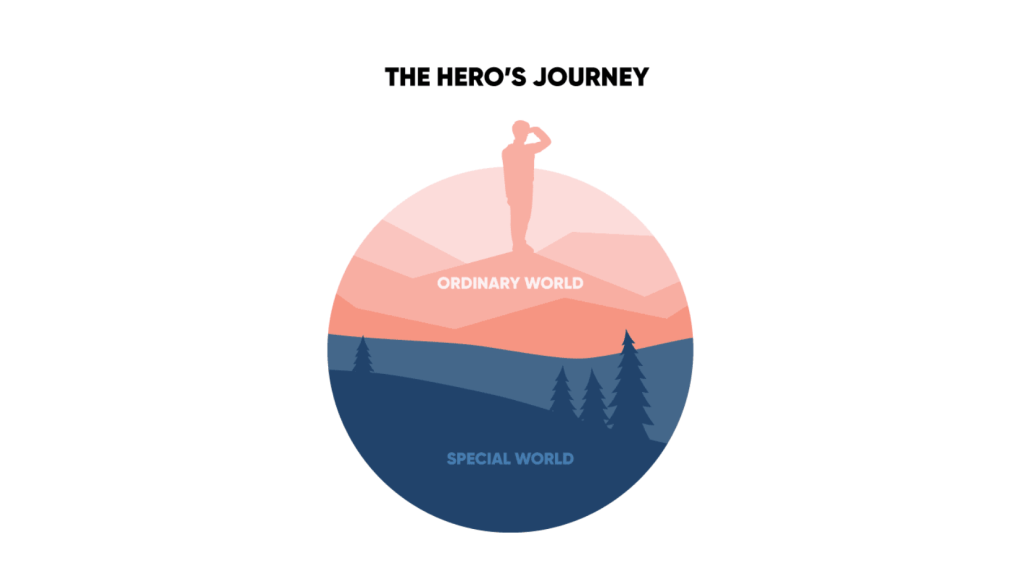
After the sextile, we have the square. This is when, in the Hero’s Journey, the real test begins – the square is the threshold the hero crosses to move from the Ordinary World to the Special World.
After the first square, the planets continue to move in their cycle, and the story continues to unfold in a predictable sequence.
The hero faces trials, confronts the ordeal, and ultimately returns transformed – a universal process of growth we all go through in life.
The Hero’s Journey And Planetary Aspects
If we take Campbell’s 12 stages of the Hero’s Journey, we can naturally map them against the 12 sign-based aspects in a planetary cycle, from the conjunction, semi-sextile, up to the opposition, and then back to the closing semi-sextile.
Through the lens of the Hero’s Journey, planets and aspects stop being just keywords and definitions. They become steps in a developmental arc – concrete moments in the hero’s journey.
When we look at planets and the aspects they make through Joseph Campbell’s Hero’s Journey template for making sense of the world, everything clicks into place:
A sextile is no longer a “soft aspect” but a sign that is asking to be read, a signal that wants to be followed, a breadcrumb that points the way forward.
The square is no longer just a “hard aspect” – it’s an initiation, a crossing-the-threshold action where we are asked to leave behind the comfort of the “Ordinary World” to step into the “Special World.”
Opening Aspects Vs Closing Aspects
Furthermore, not all sextiles, and not all squares are equal.
We have 2 sextiles in a cycle, or a Hero’s Journey, and the sextile we introduced – the supernatural help – has a very different purpose than what we call a “closing sextile” which occurs towards the end of the cycle, after the Hero has accomplished the goal.
And the 1st square, called the opening square (similar to the 1st quadrant in the Lunar cycle) has a very different goal than the closing square, which is archetypally similar to the 3rd quadrant in the Lunar cycle.
This logic can be applied to any aspect in your chart.
If you have a trine, that can be either an opening trine – happening early in the cycle – or a closing trine. Different purpose, different energy.
When we look at aspects this way, they suddenly make much more sense. Instead of isolated meanings, each aspect becomes part of a natural sequence of development.
Aspects And The Hero’s Journey Webinar
On March 22nd, 2026, Caro from the Astro Butterfly School will host a live webinar, “Aspects and The Hero’s Journey”, where she outlines the exact logic of reading aspects through the lens of the Hero’s Journey.
In the webinar, we will also outline the fascinating and little explored topic of opening and closing aspects and how they nuance chart interpretation.
You can learn more about the webinar and RSVP at this link:
[WEBINAR] Aspects And The Hero’s Journey – March 22nd, 2026
The post Aspects And The Hero’s Journey first appeared on Astro Butterfly.