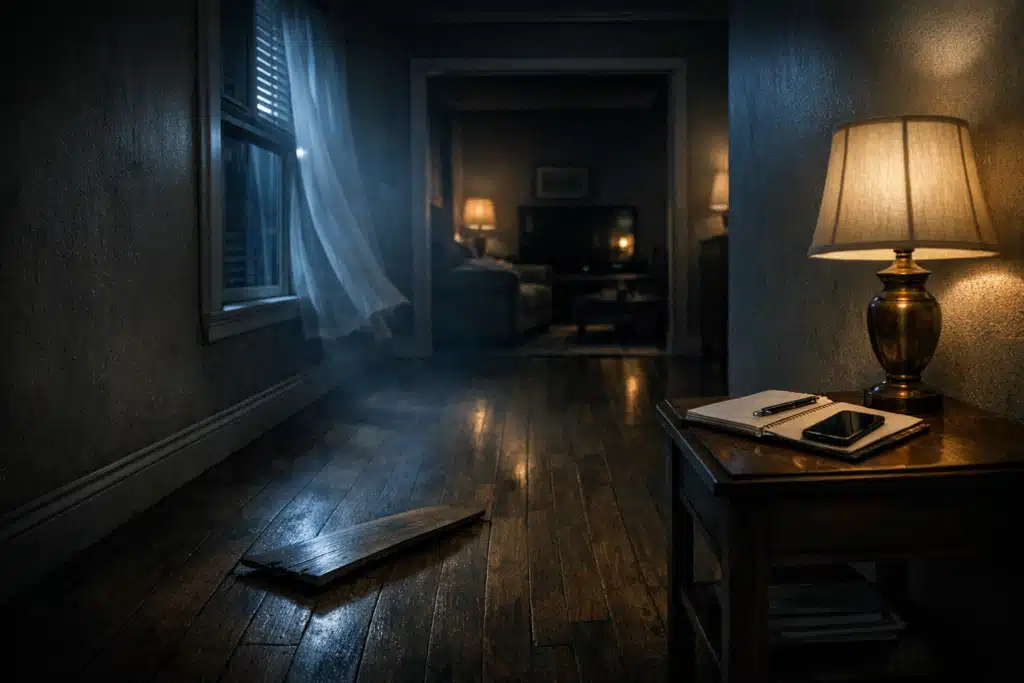
There is a tender vulnerability in wondering whether your home holds more than furniture and memories. When the floor creaks at 2 a.m. or objects seem to shift without explanation, the mind reaches for meaning. Is it imagination, energy, or something unseen? These potential haunted house signs deserve thoughtful examination.
In spiritual traditions, homes are living containers of memory. In psychology, they are spaces where perception and emotion intertwine. Let’s explore this question thoughtfully—without fear, but with curiosity and discernment.
What Do We Mean by “Haunted”?
Before jumping to conclusions, it helps to define our terms clearly.
Residual energy: The idea that intense emotions can imprint on a place, leaving an atmosphere that feels heavy or charged.
Intelligent haunting: Belief in a conscious spirit interacting with the environment.
Environmental factors: Natural causes—wiring issues, drafts, acoustics, or structural settling—that create unusual sensations.
Many reported haunted house signs fit into environmental or psychological explanations. That does not invalidate spiritual inquiry—but it invites balance.
Common Haunted House Signs—and Their Practical Counterparts
Across cultures, certain experiences are frequently described. Let’s examine them with a grounded lens.
Cold spots: Often caused by insulation gaps or air leaks near windows and vents.
Knocking sounds: Wood expands and contracts with temperature changes, especially during seasonal shifts.
Electronics behaving oddly: Faulty wiring or electromagnetic fields can interfere with devices—and sometimes with human perception.
Feeling watched: Heightened anxiety, stress, or lack of sleep can sharpen the brain’s threat detection response.
Interestingly, reports of haunted house signs tend to rise around transitional times of year—late October or early spring—when temperature changes intensify structural sounds. The autumn season, associated spiritually with thinning veils, also coincides with earlier darkness, which naturally heightens sensitivity.
When Spiritual Interpretation Enters the Picture
From an astrological perspective, heightened sensitivity to atmosphere often increases during water-sign transits (Cancer, Scorpio, Pisces). For example, during a Pisces Moon—occurring once every month for about two days—people may feel more intuitive, porous, and emotionally impressionable.
Similarly, Mercury retrograde periods (happening three to four times yearly for about three weeks) are famous for misunderstandings and technological glitches. A flickering light during such a period may feel symbolic—but it is still wise to check the bulb. According to NASA, electromagnetic fields can indeed affect electronic devices.
Spiritual interpretation becomes more compelling when:
Multiple household members report similar experiences independently.
Activity follows a consistent pattern rather than random events.
There is historical documentation tied to the location.
Even then, responsible inquiry means ruling out physical causes first. These haunted house signs deserve both spiritual openness and practical investigation.
How to Investigate Haunted House Signs Responsibly
If you sense something unusual, approach it like a gentle researcher rather than a frightened storyteller.
Document events with dates and times for at least 30 days.
Check structural explanations (plumbing, wiring, insulation).
Notice emotional triggers—does activity spike during stress?
Improve lighting and sleep consistency for clearer perception.
This method helps separate pattern from projection. Often, clarity dissolves fear.
If spiritual cleansing brings comfort—such as smoke rituals, prayer, or intentional decluttering—view it as psychological reset as much as metaphysical action. The nervous system responds powerfully to ritualized reassurance.
Mini-FAQ
Q: Can anxiety create “haunted” sensations?
Yes. Anxiety heightens sensitivity to sound and shadow, and the brain may fill in missing information with imagined threat. What seem like haunted house signs may actually be stress responses.
Q: Are children more likely to report spirits?
Children have vivid imaginations and less rigid perceptual filters. Their experiences deserve listening—but also gentle grounding.
Q: Should I consult a psychic or paranormal team?
Only after practical causes are ruled out. Choose professionals who encourage balanced investigation rather than dramatic conclusions.
Practical Takeaways
Start with structural and environmental explanations.
Track patterns over time instead of reacting to isolated events.
Notice seasonal or emotional influences.
Use calming rituals to restore your sense of agency.
Seek community discussion before escalating fear.
Your home reflects your inner world more than an unseen one. When we slow down and observe haunted house signs carefully, many mysteries soften into understanding.
So ask yourself gently: Is this space asking for repair—or reassurance? And what might shift if you approached it with steadiness instead of suspense?
A home thrives on attention, not alarm.
Disclaimer: This article explores spiritual and psychological perspectives and is not a substitute for professional structural, electrical, or mental health evaluation.
The post Haunted or Hoax? Clues Your House Might Be Ghost-Occupied appeared first on askAstrology.