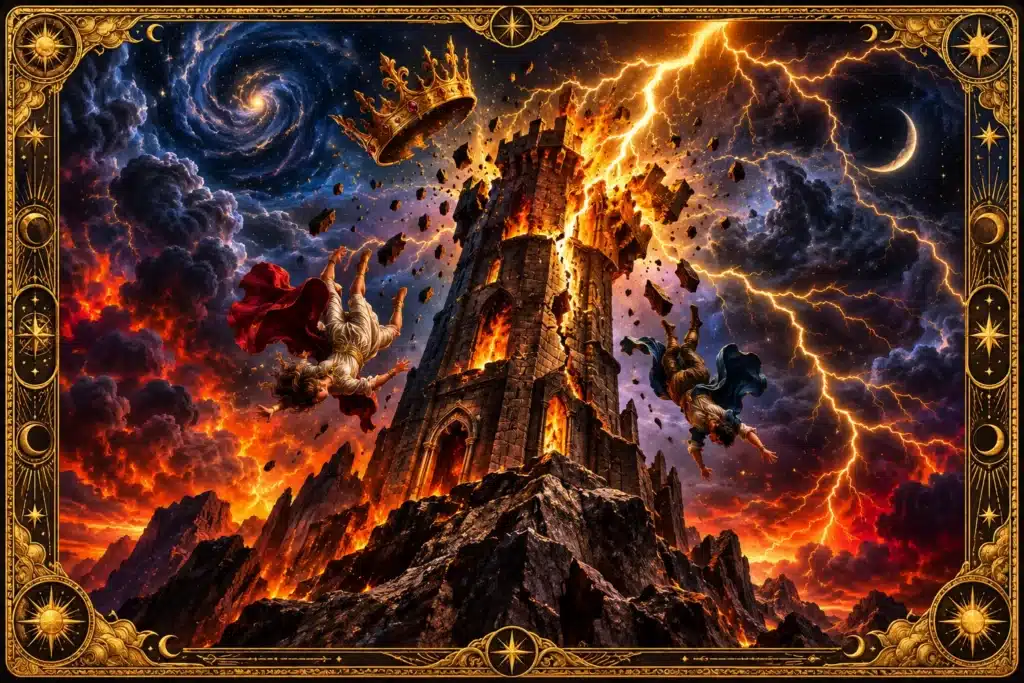
When the tower card arrives in a reading, your stomach usually knows before your mind catches up. The image is loud on purpose: lightning splitting stone, flame at the windows, two figures falling from a crown that no longer fits. It reads like a warning, and in a way it is one. Something built on a lie can no longer stand.
I have laid this tarot card down for hundreds of people, and the reaction rarely changes. Shoulders climb toward ears. Breath goes shallow. Still, after twelve years of readings, I can tell you the fear says more about us than it says about the card. We panic at the Tower because it refuses to be polite about the crack in the wall we have all been ignoring.
So breathe. Tarot reflects, it does not sentence you. Yet this card carries weight because it speaks plainly, and honesty always lands harder than comfort.
Why the Tower Card Scares Everyone Who Draws It
The tower card belongs to the major arcana, the twenty-two soul-level images that mark our deepest thresholds. In the Rider-Waite-Smith deck and in Marseille-inspired systems, the tower is struck from above by a bolt with no warning knock. There is no gentle invitation here, and that abruptness is exactly what rattles people.
Because of that image, many readers call it the most feared card in the whole deck. It looks intense because it is intense. However, fear and truth are not the same thing, and confusing the two is where the panic starts.
I will not pretend the Tower is gentle. It is not. But calling it evil misses the point entirely. It only ever burns down what was already unsound. The storm does not hate the oak; it simply exposes the branch that had rotted from the inside two winters ago.
Here is the plain version. The Tower is not bad news. Instead, it is the card that tells the truth when everyone around you is being polite about the crack in the wall.
What the Lightning Really Represents
The lightning stands for revelation. For one bright second, the sky rips open and nothing stays hidden, much like a sudden streak of light that rearranges the sky. Then the dark returns, but you have already seen.
In tarot language, that flash shows what you had filed away: the conversation you dodged for seven months, the habit quietly draining you, the promise you made when your heart was too tired to argue. Suddenly the fog lifts and clarity feels almost violent.
This is why what a Tower moment really feels like can be so disorienting. It is not always some cinematic disaster. Sometimes the whole thing is one sentence. One email. One look across a crowded room. After that, you simply cannot unknow what you now know.
What the Tower Card Is Actually Warning You About
The tower card warns you about a structure that has already started cracking. That structure is often the relationship, the job, or the story about yourself that you keep patching with duct tape and hoping holds one more year.
Now for the myth I want to break. People say the Tower means disaster is coming. Honestly, no. The disaster usually happened quietly, years ago. The Tower is simply the moment you stop pretending it did not. It is not the first crack in the plaster; it is the instant the room finally fills with daylight and you have to look.
The structure you already know is cracking
You already know what your Tower is. Deep down you have known for months, maybe longer. Perhaps your body tightens before certain phone calls. Maybe your mood drops every Sunday night like clockwork. Notice, too, how your energy goes gray around one particular person, one place, one role you outgrew a while back.
Consider a woman who pulled the Tower in a reading and went pale. She begged me to shuffle again. Two weeks later her job ended, the one she had hated for years and kept swearing she would leave someday. She called me afterward, not to mourn it but to thank me. The card did not curse her. It named the exit she had been too scared to take.
The truth the tower card keeps pointing at
A truth you keep avoiding does not soften with age. It hardens. Carl Jung wrote that the collapse of the ego, painful as it is, opens the doorway to renewal and to becoming a whole self, and the Tower stages exactly that collapse in miniature. So the card speaks now, before the neglected inner house comes down on its own schedule instead of yours.
Name the cracked structure out loud, in one plain sentence, with no hedging.
Ask yourself which specific truth you keep carefully walking around.
Notice where quiet relief shows up, even when grief is standing right beside it.
Choose one honest action you can take within the next twenty-four hours.
The Tower Reversed and the Slow Collapse
When the Tower appears upside down, the energy tends to turn inward. Reversed, the message is often delayed, resisted, or swallowed rather than released. The lightning is still crackling overhead, but you may be gripping a copper rod and calling it loyalty. If you want the fuller picture, read up on what the major arcana means when it comes up reversed before your next self-reading.
This is the slow collapse, and it is quieter than the upright version. You stay. Then you smooth things over. Slowly you get frighteningly good at carrying discomfort as if it were a virtue. Meanwhile your intuition keeps tapping the glass like a raven with news you refuse to answer.
Yes, patience is sacred. However, denial is not the same as devotion. A cracked wall may survive three loud storms and then fail on an ordinary calm morning. So the reversed card asks something simple: repair what can genuinely be repaired, and release what cannot. That distinction is the whole lesson.
How to Work With the Warning Instead of Fearing It
Work with the Tower the way a witch works with fire: respectfully, carefully, and with water within reach. Do not glamorize crisis or rush into total upheaval for the drama of it. Good ritual stays grounded. Good magic keeps a broom, a plan, and a steady hand nearby. This is also why the so-called negative cards deserve a second look, because the so-called negative cards and their real message tend to be far kinder than their artwork suggests.
Try this five-minute practice tonight. Light a candle on a heat-safe surface. Set a stone, a key, or a small twig beside it. Then say it plainly, out loud: “This is the structure that is cracking.” Name the thing without softening it.
Next, take one small step toward the truth instead of the duct tape. Draft the email. Save the phone number. Clear out the drawer. Say the honest sentence, even a short one like “I need time to think about this.” Small doors still count as doors.
When big emotions surge, pause and breathe slowly until your feet feel the floor again.
Should your safety be genuinely involved, reach out to trusted support before anything else.
If the right move stays unclear, wait for more evidence rather than forcing a decision.
Whenever relief shows up uninvited, honor it as real information about your life.
The tarot card does not ask you to love the falling stones. It asks you to stop worshiping the wall that was never safe. What comes down will make noise, of course, yet what stays standing can finally be truer, cleaner, and more alive than before. Let the fallen stones show you what was always meant to hold.
The post What the Tower Card Is Trying to Warn You About Right Now appeared first on askAstrology.