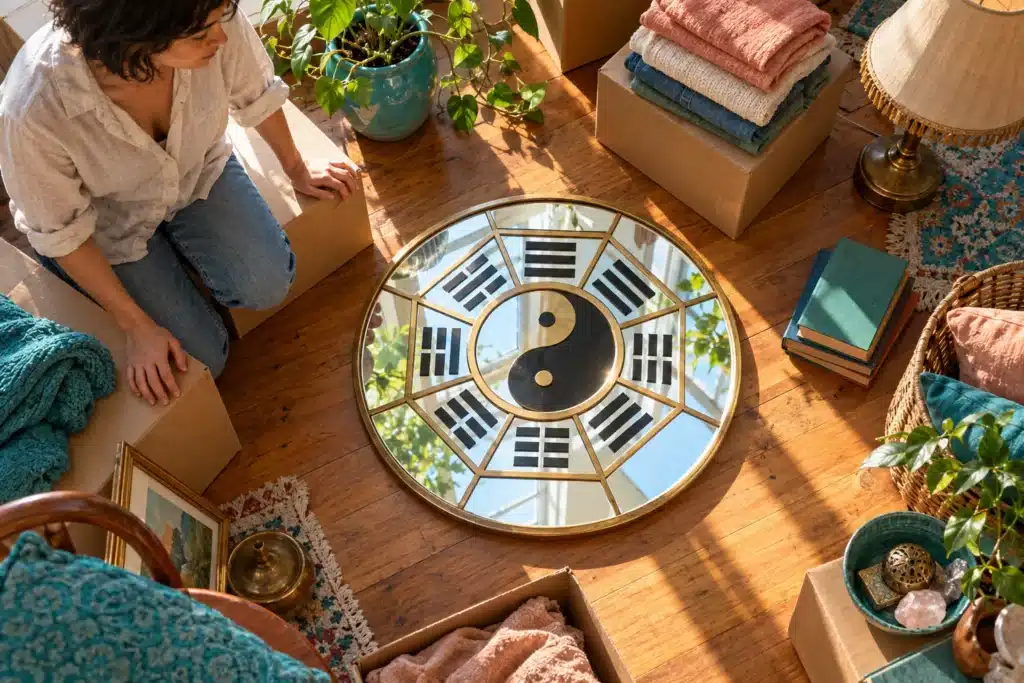
The room in your home you avoid is not random, and yes, you know exactly which one I mean. Every home has one space people route around without noticing they do it. Maybe it is a spare room, a hall cupboard, a garage corner, or that one drawer with emotional weather inside. In feng shui, the reading is about stagnation and flow, not tidiness or morality. This is perspective, not prediction.
Every Room in Your Home Is Doing a Job Except One
Most rooms have a role. The kitchen feeds you, the bathroom resets you, the sofa hosts your soft collapse after emails, errands, and one too many group chats. However, one space stops doing a clear job and starts holding the things you cannot quite face.
You know the one.
Because feng shui reads space as living energy, that stuck zone matters. It is not about being neat, stylish, or worthy of a makeover show. Instead, it points to blocked motion. If you want context on clearing what blocks the flow, think less perfection, more circulation.
Here is the test. Walk your home and name what each room is for, out loud, in four words or less. You will get through most of them fast. Then you will hit one where the sentence goes vague, and vague is the whole tell.
The Spare Room Is Never About the Spare Room
I had a spare room for two years that I described to guests as the office. It had a desk in it. I never once worked at that desk. What it actually had was three bags of clothes from a version of me that no longer existed, and a box I did not want to open. I called it the office because office sounds like a plan.
That is the trick. The space gets a name, but the name is often PR. Meanwhile, the room stores the pause between who you were and who you are becoming. It may hold grief, guilt, old ambition, family tension, or the fantasy self who was totally going to learn pottery.
Clutter is not laziness. It is postponed decisions with a roof over them.
I’ve moved four times since that flat, and the room follows me. Different address, different square footage, same function. In my experience it is never the same objects either, which is how you know the objects were never the point.
Four Things People Store Instead of Deciding
The avoided room in your home usually has an emotional inventory, even when it looks like random stuff. Still, the objects often tell on us with Oscar worthy drama.
Clothes that belong to a past body, job, mood, or love story.
Gifts you do not like, because gratitude and obligation got tangled.
Paperwork that feels boring, threatening, or weirdly adult.
A phone charger for a phone nobody in the house owns anymore.
Notice that none of those are expensive. That is deliberate. Expensive things get dealt with, because money forces a decision. The stuff that piles up is the stuff nobody is making you resolve, which means the only deadline is the one you refuse to set.
None of this means you are failing, and the room in your home is not a verdict on you. However, it may mean a choice has been waiting so long it started paying rent. If you want a gentler counterpoint, try making a corner that actually restores you, because one kind space can shift the tone.
Why You Walk Past It Without Seeing It
Avoidance is not always a choice. Sometimes it becomes a route. You turn your shoulder before reaching the door, stack one more bag outside, or say, “later,” so fast your brain files it as handled. Therefore, the room becomes invisible through habit.
Mine is the hall cupboard and I have not fixed it. I find that admitting it out loud does more than any purge I have ever attempted.
That line matters because nobody needs a fake glow up sermon. In feng shui terms, stuck energy can feel heavy because movement has stopped. The practice is old, and it reached Western decorating magazines around 1976 in a very simplified form, which is why so many people think it is about where you put a mirror. It has always been more about how a body moves through a space than about how that space photographs. According to where this way of reading space comes from, placement and flow shape how a space supports life. However, it is not a moral scorecard.
There is a second reason you skip it, and it is less flattering. Opening that door means finding out what you actually decided when you were not paying attention. The room already knows. You are the last one to be told.
Also, tidying it will not change your life. I know, rude. But noticing what the room is carrying might change your next honest sentence. Before you touch a single box, ask what decision the space has been protecting you from making.
Opening the Room in Your Home You Keep Shut
Do one small thing, and it is the same instruction I have been giving since 2019. Open the door, stand there for ten seconds, and name the feeling out loud. Not the mess. The feeling. Is it shame, sadness, pressure, hope, resentment, or plain fatigue? Finally, close the door and let that be enough for today.
Ten seconds is not a trick to get you cleaning. It is genuinely the whole task. The reason it works is that avoidance runs on never looking directly at the thing, so a short honest look breaks the loop without demanding a weekend.
This is not a project plan, and it is not bedroom feng shui. It is a quick read of the room in your home that has been holding the emotional tab. After that, you may choose action, rest, or a better ritual. Even the evening routine that resets people starts with noticing what drains you.
The avoided room is not your enemy. It is an honest little witness with bad lighting. However, once you see what the room in your home stores, you stop being haunted by a door and start being curious about your own timing. That is where flow begins, quietly, before anything looks different.
The post The Room in Your Home That Holds Everything You Avoid appeared first on askAstrology.