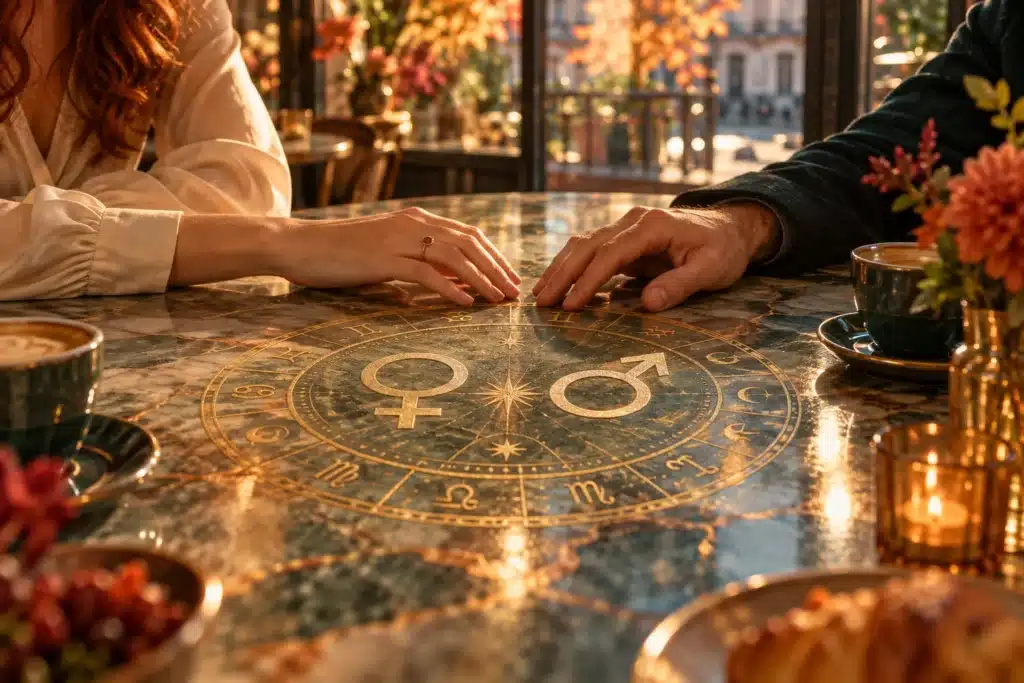
Attraction that lasts never shows up in the first three dates. It shows up later, after the performance drops, after novelty stops doing the work for free, and after someone has to choose you while mildly irritated. That is where most early chemistry quietly leaks out.
Chemistry is the least useful word in dating. It sounds mystical, but it usually hides six things wearing one coat: lust, novelty, projection, timing, relief, and a nervous system that mistook adrenaline for recognition. Two placements say more about attraction that lasts than that word ever will, and they say it far earlier.
A note on the sky first, because it shapes the mood rather than the mechanism. Venus is in Scorpio. Mars is in Leo all month. Mercury is not retrograde, so mixed signals are not static in the wires. Venus does station retrograde on October 3, 2026, at 3:00 AM Eastern, at eight degrees of Scorpio, though that station belongs to a different conversation. This piece stays on the two placements behind early attraction.
Why Attraction That Lasts Has Nothing to Do With Chemistry
Month three tells the truth.
Before that, you are dating a highlight reel. After eight to twelve weeks, however, the costume loosens. The person who seemed exceptional now has habits, delays, stress patterns and small selfish moments. Attraction that lasts therefore needs more than intense contact. It needs compatible wanting, and compatible pursuing, which are not the same thing.
In classical astrology Venus describes appetite, taste, values, and what someone wants to receive. Mars describes heat, pace, pursuit, and how someone goes after it. This is perspective, not prediction. Still, reading attraction that lasts through those two beats vague compatibility talk, because it separates desire from behaviour instead of blending them into one word.
Early passion tends to collapse when the two signals tell different stories. If you want the mechanics of that collapse, here is why early chemistry has a shelf life.
The First Placement: What Venus Actually Wants
Venus is not romance. That is the beginner error. Venus is taste, the private menu of reassurance, loyalty and affection that a person treats as proof of being loved.
With Venus in Scorpio the collective mood turns serious and loses patience with decorative flirting. Scorpio is fixed water, so feeling wants depth and memory. A Scorpio Venus does not relax around half-truths. It scans.
A natal Venus, however, may want something else entirely: conversation and mental oxygen in Gemini, unhurried comfort in Taurus, room before closeness in Aquarius.
I have noticed that this quietly settles attraction that lasts long before anyone says so out loud. I read it wrong on my own chart more than once. In my late twenties I spent eighteen months with someone whose Venus sat two degrees from mine, and I treated that as a guarantee. Our tastes agreed about everything and we never once argued, which is precisely why I missed that neither of us ever moved first. I now read the Mars pair before the Venus pair. Agreement about taste explains why two people like each other. It has never explained why they stay.
So ask early what makes this person feel chosen once the first rush has faded, and what they keep asking for, directly or sideways.
The Second Placement: How Mars Goes After It
Mars is where the fantasy gets legs, and where attraction that lasts either finds a motor or stalls. Venus may want devotion, but Mars decides whether someone pursues with nerve, delay, pressure, avoidance or clean follow-through.
Mars is in Leo all month, so the surrounding mood around desire runs expressive, proud and visibly hungry for an audience. A Leo Mars wants to be admired while acting. That can look like courage. Sometimes it is. The risk is performance quietly replacing presence, and the two are hard to tell apart on a good night.
If you want the physical layer of this, look at how your Mars sign shapes physical connection, because touch tends to expose Mars faster than conversation does.
Here is the raw test, and in my experience it sorts attraction that lasts from the other kind within a fortnight. The tell is how someone behaves when plans change late, not how they behave when everything goes well. Do they adapt, punish, vanish, or repair? Meanwhile Venus is still whispering what it wants. Mars answers with what it actually does, and Mars is the one telling the truth.
When the Two Placements Disagree
The two disagree when wanting and pursuing run on different instincts. That is not automatically a problem. Rather, it is a wiring issue someone has to name out loud before month three exposes it, and it remains the most common reason attraction that lasts fails to arrive.
Take the pairing sitting overhead right now. A Venus in Scorpio may want total emotional honesty and private loyalty, while a Mars in Leo pursues through display, pride and grand gestures. The wanting says prove you are real. The doing says watch me shine. Fast, intense attraction follows. Then the friction arrives, because one half wants the door closed and the other wants the room to applaud.
I once spent a whole winter convinced a relationship was working because we never argued. We had nothing to argue about. By March I was picking fights just to feel the room move. That was not incompatibility. That was two placements answering different questions, and nobody stopping to ask which question mattered. I have seen the same split in client charts often enough that I now raise it in the first session.
I do not buy that opposites attract and therefore last. Opposites do create voltage. Yet attraction that lasts needs translation between two systems, not just the charge that jumps between them. For a cleaner frame on that, read what sign matching really tells you.
Astrology has organised character through symbolic correspondences for a very long time. The useful question never changes: does the symbol describe a pattern you can actually watch happen?
How to Read Attraction That Lasts in Someone New
You do not need a calculator on date one. You need attention. Birth charts help, but behaviour is the living chart, breathing across the table from you.
Three questions do most of the work here:
What does this person move toward when nobody is rewarding them for it?
How do they behave after disappointment, delay, or a bruised ego?
Do their stated wants match their repeated choices over three weeks?
Before you romanticise the answers, separate the two. Venus is what someone says they value and calls beautiful. Mars is how they pursue, protect, compete and repair after friction. When both tell a similar story, attraction that lasts has somewhere to stand. When they do not, the split stays invisible until someone names it out loud.
Finally, try a seven-day version of what I do with client charts. Each evening write two lines: their Venus seems to want, their Mars seems to do. After a week, circle the repeated verbs and ignore the adjectives. Adjectives describe the highlight reel. Verbs describe the person who shows up in March.
The post The Two Placements That Decide Whether Attraction Lasts Past Month Three appeared first on askAstrology.