
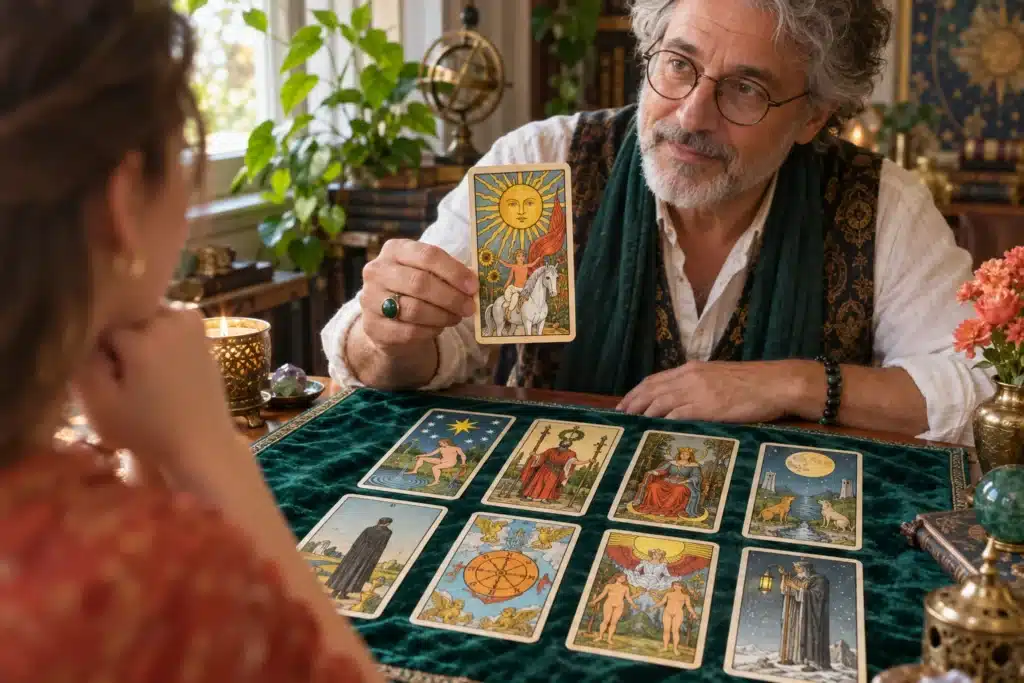
The most common tarot question is not about fate, fortune, or some cinematic sign from the universe. It is much more human, much more tender, and, honestly, much more Los Angeles traffic at 6 p.m.: does this person think about me? Readers hear it constantly, and readers say people lower their voice slightly when they ask it, even alone in a room. Today, because Venus turned retrograde on 3 October 2026, that question is going to feel louder for many hearts.
The Most Common Tarot Question, Said Out Loud
Here it is, said out loud: does this person think about me? That is what readers consistently report, in some form, across love readings, situationship readings, and the occasional ‘we made eye contact at Erewhon’ spiral.
It sounds small, and it carries a whole movie inside it. Hope, fear, pride, longing, and the tiny risk that your intuition has been doing unpaid overtime.
Everyone asks it.
Readers reframe it because it is closed. A closed question asks for yes, no or a fixed fact, while an open one asks what you can see, choose, learn or change. This matters because tarot is usually stronger at opening a scene than stamping a final answer on it.
Still, the pull makes sense to me, and I ask the bad version first most times. Any common tarot question you already know the answer to is not a reading, it is a receipt.
“I asked a reader once whether someone was thinking about me, and she put the cards down and asked what I would do with the answer. Nothing came to me. I had wanted the question to be the end of something and she turned it into the start of a much longer conversation, which is not what I had paid for and is exactly what I needed.”
Why It Is Almost Always About Someone Else
Why is the common tarot question aimed outward so often? Desire makes detectives of us, and a delayed text reads like a secret lunar transit. We look outward because looking at ourselves feels rude, like turning the lights on during a moody music video. The cards drag the spotlight back anyway.
I reject the cliche that asking about someone else wastes a reading. It is not wasteful to wonder where you stand, especially when the energy between two people feels foggy or strangely unfinished.
But it can become a hiding place. Meanwhile, the real ache is often closer: Do I feel chosen? Am I safe to want this? What would I do if the answer were no, yes, or maybe?
Still, none of this is really about surveillance. It is about wanting a sign that your feeling has somewhere to land.
Since Venus turned retrograde on 3 October 2026, the common tarot question has got extra sparkly and extra annoying. Retrograde weeks traditionally pull old love themes, past crushes and unfinished emotional tabs back onto the screen, so more people reach for the cards hoping the universe will read somebody else’s mind. I have noticed readers get the same three names in a single afternoon during these weeks.
The Runner Up: When Will It Happen
The second most common tarot question is the timing one: when will it happen? That sounds practical, because clocks feel clean, while feelings are basically spaghetti in designer sunglasses.
Timing questions disappoint because they ask tarot to act like a calendar app. You want Tuesday at 4:12, and the cards answer with mood, readiness, blockage or choice. That is not the cards being coy, it is them pointing at conditions: what needs attention, what has stalled, where your power returns.
Timing questions feel less exposed. Both ask for relief before they ask for truth.
Think of it this way. A common tarot question about timing can become what has to shift for movement to be possible, and that is a better door. If patience is the whole message, you might want the card that says not yet, and means it kindly, as a separate card-focused read.
None of this explains individual card meanings. It is about the shape of the questions, and why your heart reaches for one form first.
What Readers Ask You Instead
Readers ask something else instead, because the better question sits one inch to the left. Still yours, just with the camera turned toward your agency.
When readers hear the most common tarot question, they often keep the feeling and change the angle. That is the craft, and honestly, that is the magic trick.
Instead of does this person think about me, a reader might ask what you are learning about your own needs through this connection. That keeps the emotional truth and hands you something to hold. Instead of when will it happen, they might ask which choice helps you meet the next step with clarity. Hope survives, and you stop waiting around like a side character in your own story.
Sometimes the reframe of a common tarot question gets sharper still: what am I refusing to admit? If you are ready for that mood, go read the card that shows up before a straight answer later, because straight answers have their own vibe.
If your real issue is a fork in the road, not a crush, a layout for when you have to choose may fit better after this. And if you want the larger human history of seeking signs, how people have always asked these questions shows that humans have been asking fate-adjacent questions for ages.
Try this tiny ritual before your next reading: write the closed question first, then write what you would do with each possible answer. Finally, turn that into one open question.
This is perspective, not prediction. The cards can guide the room, but you still decide where to sit.
What the Most Common Tarot Question Says About You
So what does it say about you? Not that you are needy, dramatic, doomed, or wasting anyone’s time.
It says you are locating yourself inside uncertainty. When someone matters, their inner world becomes the missing map.
It also says you may be hoping for permission. To reach out, to let go, or simply to stop rereading one message like it was directed by Christopher Nolan.
Still, your better question is hiding under the common tarot question you started with. The first is the doorbell. The second is the house.
Ask what you are afraid you will learn. Then what you already know but keep outsourcing. Then what self-respect would do in the coming days.
Here is the sweet part. It is popular because it is deeply human. Not silly. A flare. Treat it kindly, then make it braver.
The first ask is usually about them, but the useful insight returns to you.
Timing questions help, yet readiness and choice matter more than a date.
Reframe closed asks into open ones before you sit down with the cards.
Next time the common tarot question shows up in your mouth, let it. Ask it out loud, badly, the way everyone does. Then ask the second one, the braver one sitting just underneath, and give the cards something worth answering.
The post The Question Tarot Readers Hear Most, and What It Says About You appeared first on askAstrology.
