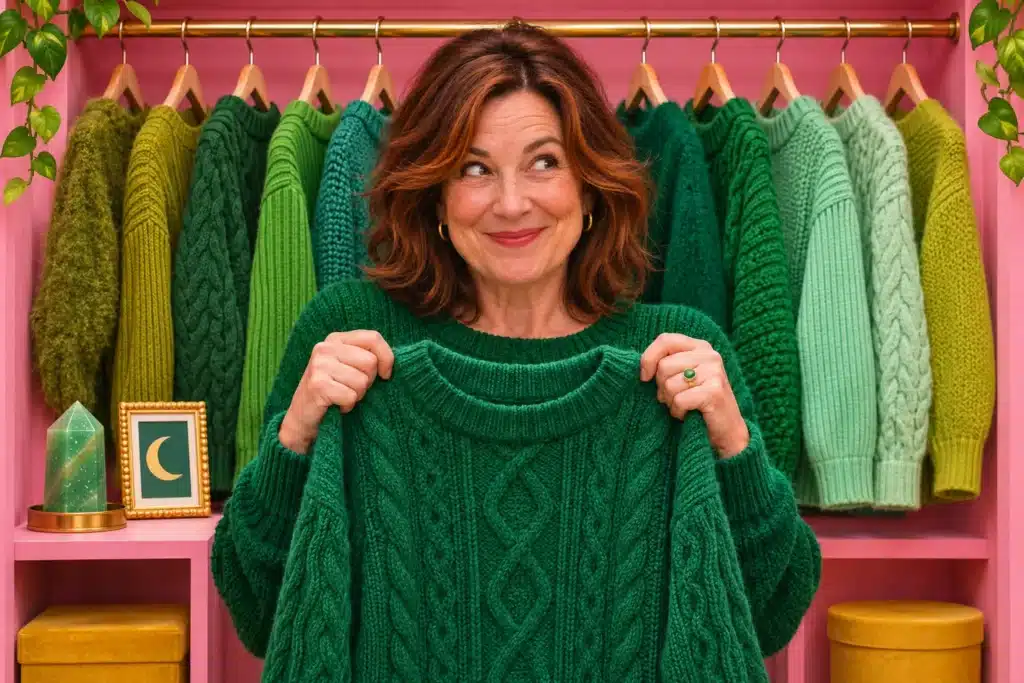
Wearing the same color over and over can feel like a tiny closet conspiracy, especially when your laundry pile keeps exposing you. That black sweater, blue button-down or cream knit may be doing more emotional labor than your group chat.
Color preference looks personal, because it is personal. However, research suggests your favorite shade often carries attachments: places, people, teams, moods, and tiny internal movie scenes. So before you accuse yourself of being predictable, let’s retire the idea that wearing one color all the time makes you boring.
What Wearing the Same Color Says About You
Wearing the same color is often a comfort move. Because mornings already ask too much, your brain may reach for one dependable shade to cut down on decisions. One less choice before coffee? Honestly, chic.
Your favorite color can become a wearable identity tag. Fashion magazines may call it a signature palette, while your nervous little 7:43 a.m. self calls it safety. This offers perspective and predicts nothing. Still, the pattern can show what kind of energy you are trying to carry into the day.
Your closet is more of a memory archive than a style statement. A color may point toward a feeling you want back: calm, confidence, softness, attention or protection. Therefore, the better question is ‘What does this color bring back into the room?’
That is where the magic gets practical. If you keep choosing navy, perhaps you like feeling polished without shouting. If pink keeps winning, maybe you want warmth. And a closet full of black can be a clean boundary between your inner world and everyone else’s opinions.
The Berkeley Research on Why We Like Certain Colors
In 2010, Stephen Palmer and Karen Schloss of the University of California, Berkeley, published their ecological valence theory in the Proceedings of the National Academy of Sciences. In plain words, ecological valence means your brain links colors with the things you have liked or disliked before.
The theory says people like colors strongly tied to things they like, such as blues with clear skies and clean water. Meanwhile, people tend to dislike colors tied to things they dislike, such as browns with rotten food. The color itself becomes a shortcut to a stored reaction.
This matters for anyone wearing the same color for years, because preference is learned through association. Blue stops being just blue after years of summer afternoons, ocean vacations, school uniforms, favorite mugs or heartbreak playlists. If you want a refresher on color basics, start with a beginner’s guide to shade and hue.
Color also has a physical side, made of light and wavelength. You can peek at the physics behind what the eye calls hue if you want the nerdy glow-up. Your closet then adds biography to that biology.
Sometimes green is just the color that was on sale, and I have to admit that too. Still, when a pattern repeats across three seasons, five sweatshirts and eleven versions of the same sweater, curiosity deserves a seat.
Why a Favorite Color Can Change Over Time
In 2011, the same team compared students at Berkeley and Stanford. Each group liked its own university’s colors more than the rivals did, and the preference grew with school spirit. Their conclusion: color preference is learned from what a color is attached to.
That finding is deliciously human, and it explains why wearing the same color for years can end almost overnight. Because color follows meaning, your favorite shade can shift after a move, a breakup, a new job, a victory, a loss, or a fresh era of selfhood. The color on the hanger barely changes. The attachment changes a lot.
For three years I owned eleven green sweaters. I never planned it. My roommate counted them while helping me move and held up the eleventh like evidence in court. ‘Who hurt you?’ she asked. Nobody, I said. Then, halfway through taping a box, I remembered that my grandmother’s kitchen in Pasadena had been painted that exact sage, and that I started buying green the winter after she sold the house.
Eleven sweaters. One kitchen.
After that, green looked a lot less random. It had become a portable room, a soft little Pasadena spell with sleeves. I’ve kept four of them, and I still reach for the sage one first. So if your favorite color recently changed, hold off on judging the shift. Ask what the shade has started carrying.
Astrology can add its own symbolism, and this piece stays with psychology and personal meaning. If you want the cosmic angle later, save the shade tied to each sign for another tab.
Reading Your Own Closet
If you keep wearing the same color, reading your closet starts with evidence. Pull out the colors you wear most during a normal week and lay them where you can see the pattern. I’d look at tops first, because shades near your face carry the strongest mood message.
Next, ask what each color is attached to. Because the Berkeley research points toward learned associations, your answer may involve a person, a place, a season, or one very specific Tuesday. Pay attention to the first memory that shows up.
Black: focused, sleek, a little less available for random commentary.
Blue: calm and trustworthy, the color people wear to hard conversations.
Green: steady and restored, often close to a memory of home.
Red: visible, bold, ready to be taken seriously.
Cream: soft and quietly pulled together.
Pink: playful, tender, a little more adored.
Those are what people commonly report, and your own story outranks them. Your black dress could mean power, grief, simplicity, nightlife, Catholic school, or the fact that lint rollers have betrayed you. Context is the whole plot.
Objects collect emotional meaning through repetition, too. If your closet feels crowded with old versions of you, this piece on objects that hold onto old energy pairs beautifully with a color audit.
When Wearing the Same Color Stops Feeling Like You
Sometimes the same shade starts feeling flat. Perhaps the color once helped you feel safe, and now it feels like hiding. Or maybe your favorite palette belonged to a version of you who needed different armor.
Try a one-week experiment. Choose one new shade near your face: a scarf, a knit, a collar, a hat, or a tiny tee under a jacket. Keep the rest of your outfit familiar, because you are running an observation, and a Hollywood makeover montage would ruin the data.
For the first two days, notice your reaction in the mirror before anyone comments. Then track how friends or coworkers respond, if they respond at all. By the end of the week, ask whether the color changes your posture or your voice. Keep the shade only if it feels true on your body and in your life.
Finally, wearing the same color can be devotion, convenience, memory, taste or pure sale-rack destiny. You are still allowed to update the palette when your life asks for a new feeling. I’m testing a rust-colored scarf this month, and so far my mirror approves, even if the four green sweaters I kept are clearly jealous.
The post Why You Keep Reaching for the Same Color in Your Closet appeared first on askAstrology.