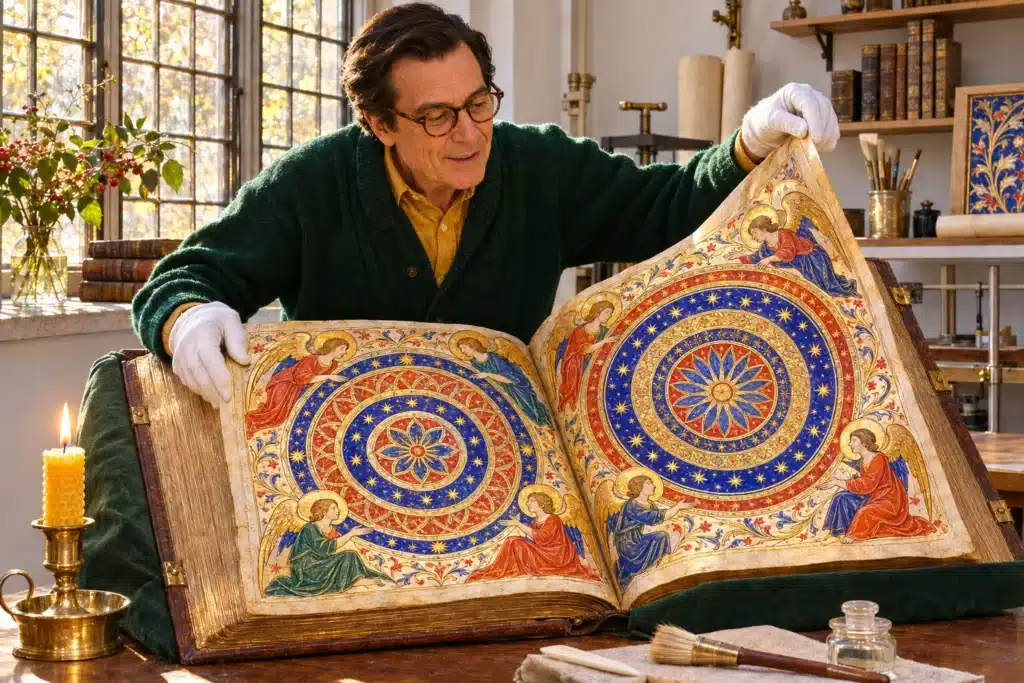
The Ars notoria still feels daring to a modern reader because its promise is so intimate: learn faster, remember better, reach wisdom through prayer. However, this medieval book asks for a careful historical eye. It was a Latin ritual of prayers to God and the angels, ascribed to King Solomon, and it grew from the 13th century, possibly the late 12th. The promise is the most modern thing about this book. Still, what follows offers perspective and predicts nothing.
What the Ars Notoria Promised a Medieval Student
Could a student receive university knowledge through prayer, fasting, discipline, and sacred figures? That question sits at the heart of the Ars notoria, also called the Notory Art. Its manuscripts survive, so the book itself is easy to find. What stays mysterious is the experience its users were reaching for. It asked for the seven liberal arts, philosophy, and theology, given in study order, like rungs on a ladder toward sacred learning.
The seven liberal arts were grammar, rhetoric, logic, arithmetic, geometry, music, and astronomy. In medieval schools, these arts formed the foundation before higher study. Therefore, the Ars notoria aimed very high. It promised a stronger memory, sharper understanding, and the whole curriculum, asked of God and the angels under a strict ascetic discipline.
King Solomon’s name matters here as a claim of authority. Tradition made Solomon the master of wisdom, of angels and spirits, of ordered knowledge, so his name gave the ritual prestige. The heavenly source was a belief, held within a Christian world where prayer, discipline, and learning could belong to one sacred pattern.
It is tempting to say that medieval readers were simply gullible. I don’t buy it. Many were ambitious, anxious, devout, and hungry for success. That sounds familiar.
One Page of the Paris Manuscript
Then came the figures.
In Paris, the National Library of France keeps manuscript Latin 9336, titled ‘Sacratissima ars notoria’, and it gives the book a body you can check for yourself. It is a 14th-century manuscript of 28 leaves with paintings, each leaf about 17 by 11 inches. The pages are digitized, and you can browse the Paris manuscript record and its digitized pages.
The reader prayed while gazing at figures called notae. That word gives the Ars notoria its name, and historian Julien Veronese studied these visual forms closely. The notae are painted diagrams, crowded with pattern, color, and tiny Latin lines. Meanwhile, a prayer sits beside them, so the eye and the voice work together.
I first opened the digitized Paris copy on a rainy evening, expecting a cramped little spellbook. Instead the screen filled with a page nearly the size of a tabloid, painted figures with tiny Latin lines winding around them. I caught myself whispering the first words, the way you read a recipe aloud. Then I laughed: I had a deadline, and no angel was going to write it for me.
Because the page is large, the ritual feels physical. The student looked, repeated, waited, and hoped. No modern shortcut hides there.
A Monk Who Tried It, Then Wrote His Own
Early in the 14th century, John of Morigny brought this story into sharper human focus. He was a Benedictine monk educated at Chartres and Orleans. According to Claire Fanger’s 2012 work on his case, John described his own experiences with the Ars notoria, including visions that he understood through his religious life.
Afterward, he wrote an alternative text called the Liber florum, the Book of Flowers. His work did more than copy the older ritual. It answered it, revised it, and reframed a practice that had become powerful and troubling in his own memory.
However, his visions remain his own testimony. A testimony is a personal account, valuable for history because it shows what someone believed and reported. It does far less as proof of an outside effect, which is why his story stays a testimony.
One person’s account can reveal desire, fear, devotion, method, and self-interpretation. It cannot become a laboratory memory test. Still, John matters because he shows a reader wrestling with the Ars notoria from inside the medieval world.
For a separate occult book story, see a cipher book that stumped John Dee. Here, the lamp stays on Latin 9336 and its medieval readers.
What Historians Can and Cannot Say
Nobody can tell what those prayers did to a student’s memory, and I cannot either. No surviving account works like a memory test, with a before, an after, a control, and a measurement. Therefore, the honest answer is modest.
Still, historians can trace patterns. First, repetition and focus may have changed attention or confidence. When a reader repeats prayers for days, watches a figure, and keeps a strict ascetic discipline, the mind may gather itself. That says something about practice, expectation, and concentration.
Second, the Ars notoria offered hope of privileged access. A student facing grammar, logic, theology, and philosophy could feel trapped by slow progress. The book suggested that divine order might meet human effort, and that hope still pulls hard.
Third, for believers, knowledge could arrive as a divine gift. In that reading, the angels took part in learning. Fourth, success stories may have been amplified because failure rarely makes beautiful copy. An impressive tale travels faster than quiet confusion. None of these readings makes the ritual a proven way to learn faster.
Over the years I have turned the pages of a few grimoire facsimiles in library reading rooms, and they always surprise me the same way. They are working objects, with corrections in the margins and corners darkened by thumbs. That is the right frame for this one too. It was a book people used, in hope, at a desk. If you like old divination books, an ancient book of numbered answers shows another way readers sought guidance through text. Different book, same human ache: show me the path.
Why the Ars Notoria Still Pulls at Us
The Ars notoria still pulls at us because learning can feel holy. Before a test, a deadline, a new language, or a serious book, many people want a blessing as much as a technique. We light candles, sharpen pencils, tidy desks, choose music, and ask the universe for focus.
However, the medieval ritual also exposes a temptation: knowledge without long study. That dream has never left us. Today it appears in intense productivity systems, instant courses, and bright promises of radical success. The medieval version wore Latin, angels, and Solomon’s name.
Because this is history, the book works best as a mirror. Notice what it awakens in you, whether that is a love of learning, a fear of failure, or the old wish to be chosen. A ritual can mark a personal change, and the change itself still asks for practice.
Modern angel traditions still fascinate readers, and for a lighter bridge you might enjoy the archangel linked to your sign. Finally, the gentle question remains: when you seek knowledge, what part of you is asking for help, and what part is ready to practice?
The post This Medieval Book Promised University Knowledge Through Angels appeared first on askAstrology.