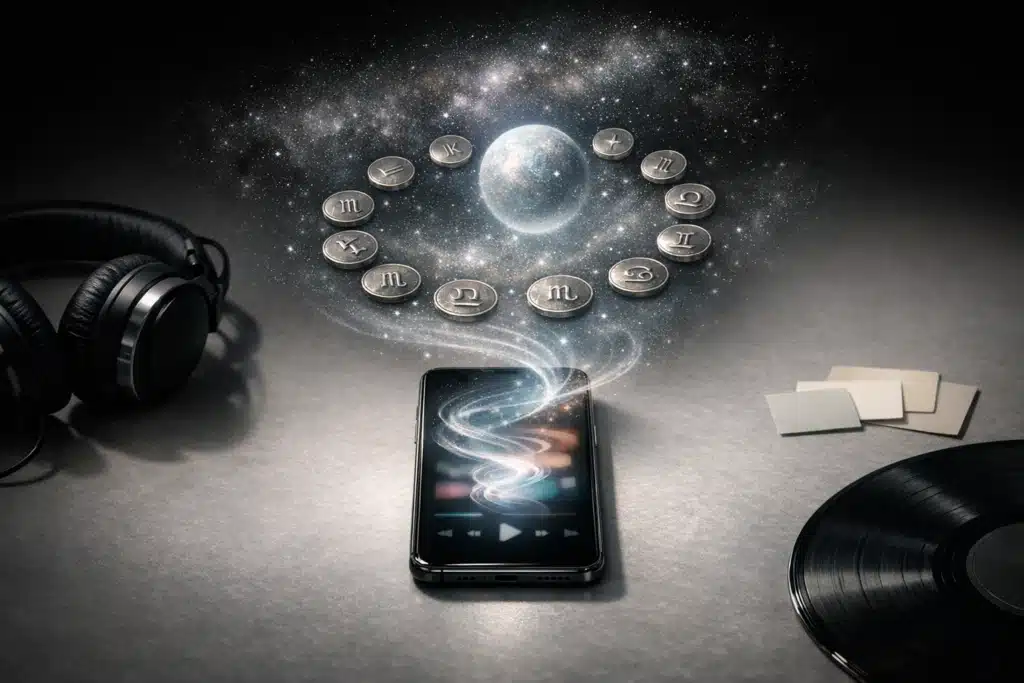
Your spotify playlist past life is hiding in plain sight. The songs you replay at 2am, the chant your algorithm keeps surfacing, the third track you always skip without thinking. None of it is random.
Open your top played. Now.
There is a song from a decade I never lived in that I knew before I had heard it twice. The lyrics arrived before the second chorus. I stopped explaining that one to people who roll their eyes at the word soul.
This is what your spotify playlist past life looks like in practice. Music bypasses the parts of you that filter. Your body recognizes things your brain has never met. Spotify Wrapped is more accurate than your therapist, and I am not joking to be cute. The data points to something older than mood.
Below, how the soul-music link actually works, five track types that reveal a past life, and a ten-minute exercise so you can read your own.
How Your Spotify Playlist Past Life Pulls Memory From the Body
However, memory does not live only in the brain. Indeed, the body holds it. The breath holds it. Music goes around the cortex and lands in the chest before the mind catches up.
That moment when a song makes you cry without context? Cellular recognition. The same way smell pulls you back to a kitchen you have not stepped into in twenty years, sound pulls something older. Sometimes far older.
I might be projecting. The patterns are too consistent to ignore. When the same century keeps showing up in your playlist, when you instinctively know the next note in a song you have heard once, the mind is not running the show. Something underneath is.
If this resonates, you may already be sensing other ways the body knows things first. The classic signs your third eye is opening often coincide with this kind of music recognition.
5 Tracks That Reveal a Past Life
First of all, these are not exact incarnations. They are vibrational signatures. The body recognizes a frequency it has lived inside before. Your spotify playlist past life will lean toward one or two of these. Not all five.
Songs With War or Loss Energy
For example, battle hymns and civil-war ballads. The kind of grief that shows up in folk songs about boys who never came home. If your playlist holds these, the body is remembering a violent or interrupted ending. The signal is sharp, not sad. Different thing.
Oceanic and Water Sounds
Whale song, deep ambient, anything that sounds like it was recorded underwater. Coastal life, fishing communities, isolated islands. Water-life souls almost always recognize this immediately and feel calmer in cities near a port without knowing why.
Court, Aristocracy, and Period Music
Baroque chamber pieces, harpsichord, lute compositions, anything that conjures a powdered room and a chandelier. Court life leaves a specific imprint. So does servitude inside court life, and the two often surface in the same person at different ages.
Frontier and Dust-Bowl Tracks
Old country, early blues, anything that sounds like a guitar on a porch at dusk. Migration, hard work, leaving a place behind. The pull here is geography, not romance. The body remembers walking.
Monastic, Silent, and Ritual Music
Gregorian chant, 432 Hz frequencies, deep drones, repetitive ritual percussion. Monastic vows, contemplative life, devotion. This one is the most underestimated, because the silence between the notes is what matters.
How to Read Your Spotify Playlist Past Life in 10 Minutes
Now, pull up your top played. Then, look for three patterns at once. Decade. Language. Instrument. The decade tells you the era your soul keeps reaching for. The language flags geography or community. The instrument hints at lifestyle. Hands on a plough sound different than hands on a cello.
Pay attention to the third song you skip every time, without thinking. That one is louder than the songs you keep. The skip is information. It usually means the song is too close to a memory the body has not finished processing.
If you want a deeper read, try one of these self-hypnosis techniques to access deep memory while playing one of your repeating tracks on loop. Some people write entire scenes after twenty minutes. Others get nothing. Both are useful data.
When the Same Song Keeps Finding You
Algorithms do not explain the song that follows you across three apps and two friends in one week. Spotify, then a barista, then a passenger in a friend car. That is not Spotify. That is signal.
In fact, the body responds first. Goosebumps. A chest tightness with no obvious source. Knowing the lyrics before they play. These are the markers practitioners flag for past-life imprints, the same way they flag synchronicities in your life and what they mean: not as coincidence, but as the universe handing you a soft tap on the shoulder.
Therefore, music is not just music. The mind would like that to be true. The body has never agreed.
What to Do With Your Spotify Playlist Past Life Findings
So, do not force a story. The pull comes first. The narrative comes later, if at all. A serious mistake is to label your spotify playlist past life imprint a name and a century within ten minutes of noticing it. The signal does not work that way. It unfolds.
Instead, sit with the recurring track. Journal one sentence about what it makes the body want to do. Run, kneel, hold a child, fight, sleep. The verb tells you more than any biography would.
If the pull deepens, you can explore the broader practice through 9 ways to connect with your spirit guides or read about the doctrine of rebirth across traditions for context. The frameworks differ. The patterns rhyme.
Your top played already knows the answer. You are catching up.
The post Your Spotify Playlist Reveals Your Past Life: How to Read It appeared first on askAstrology.