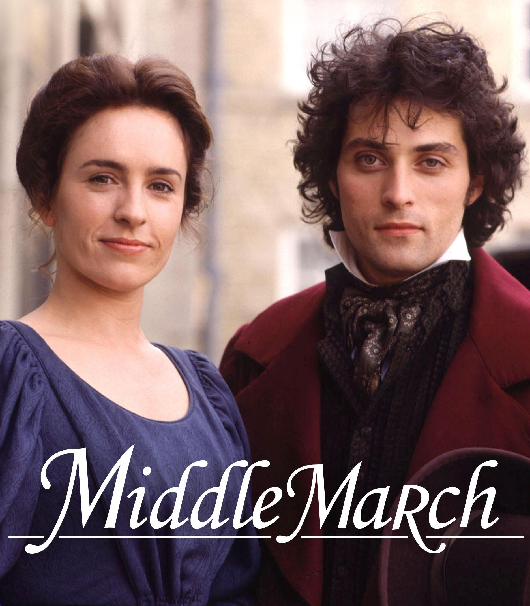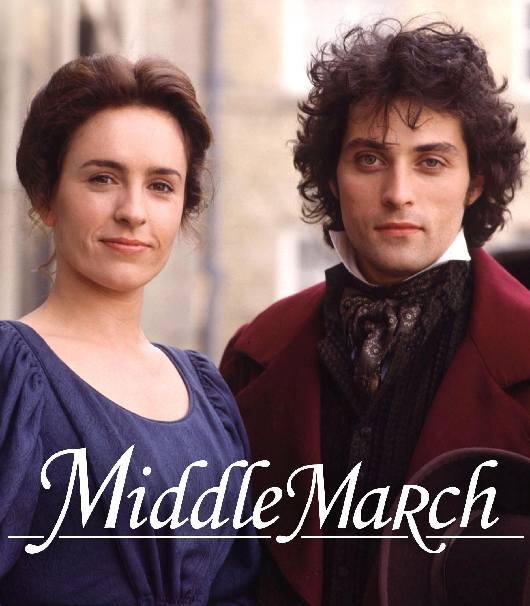
Middlemarch by George Eliot has been voted the best novel of all time in a Guardian poll of writers, academics and critics. A 900-page portrait of 19th-century provincial life it is not embraced with the same enthusiasm as Austen, Bronte or Dickens but Virgina Woolf declared it “one of the few English novels written for grown-up people”; and Martin Amis called it “a novel without weaknesses”.
Unlike Austen it does not lead up the golden staircase to an enchanted marriage, indeed it focuses on two unhappy ones. Dorothea, an intellectual 19 year old, a passionate reformer, hitches herself to a dull and wizened scholarly clergyman only to fall in love with a young writer. An equally idealistic young doctor is seduced into marriage by a frivolous, spendthrift wife and sees his research dreams crumble. Plus myriad other sub-plots. It was published in instalments in 1871 and 1872.
A reviewer said: “ This is a novel about what it means to be good. It is a celebration of the quiet heroism of unremarkable lives, all those who “rest in unvisited tombs” as the melancholy last line has it.”
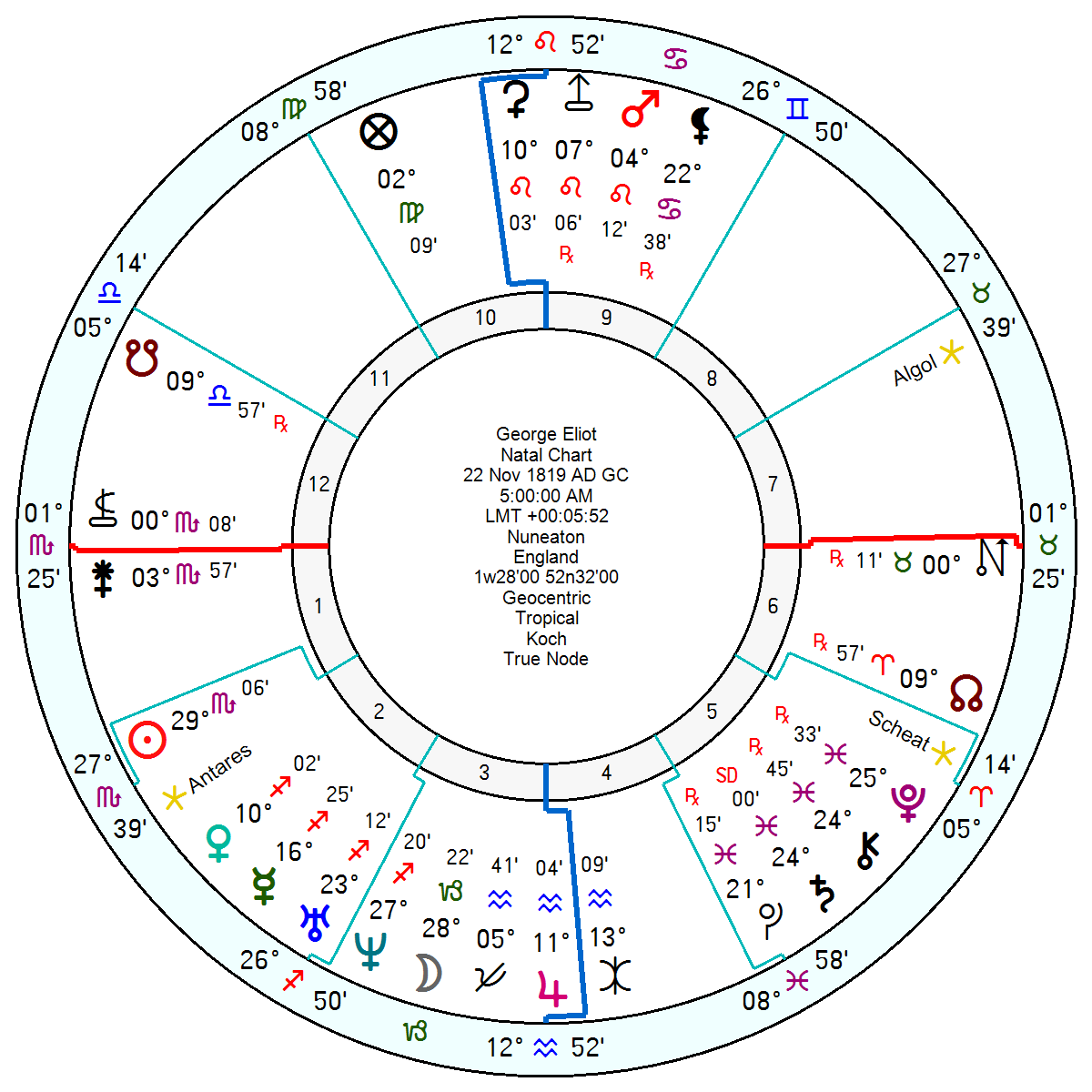
George Eliot, born Mary Ann Evans, 22 November 1819 5am Nuneaton, England, was not considered attractive as a child and therefore unlikely to marry so was better educated than most girls; latterly she soaked in classical literature in the library of the grand house where her father was estate manager. She wrote under a masculine pseudonym to escape the taint of ‘silly women’ novelists and to avoid focus on her unconventional (in Victorian times) open relationship with a married man.
As an adult she mixed in London in literary and social reformist circles being anti-orthodox religion and keenly aware of the split between the haves and the have-nots. In her late thirties she started to write popular fiction as opposed to philosophical and political essays and became a favourite of Queen Victoria’s despite her scandalous reputation.
She had an intense Scorpio Sun trine a formidably strong and determined if bleak Saturn Pluto, Chiron, Scheat conjunction in Pisces in her creative 5th house. Her Mercury in Sagittarius was conjunct an inventive and highly strung Uranus Neptune also in Sagittarius all three square Saturn Pluto so she must have had bouts of melancholy. What would keep her optimism afloat was a lively opinionated Mars in Leo in her communication/publishing 9th house opposition Jupiter in humanitarian Aquarius, and trine Venus in Sagittarius. She also had an inspirational Fire Grand Trine of Mars trine Venus trine an independent-minded Aries North Node.
Her Sun/Moon midpoint was conjunct Neptune and square Saturn Pluto Chiron Scheat so she was hardly designed for a conventional marriage. Latterly after her long time partner died, she did marry a man 21 years younger than himself, who attempted suicide on their honeymoon and she died some months later from kidney disease.
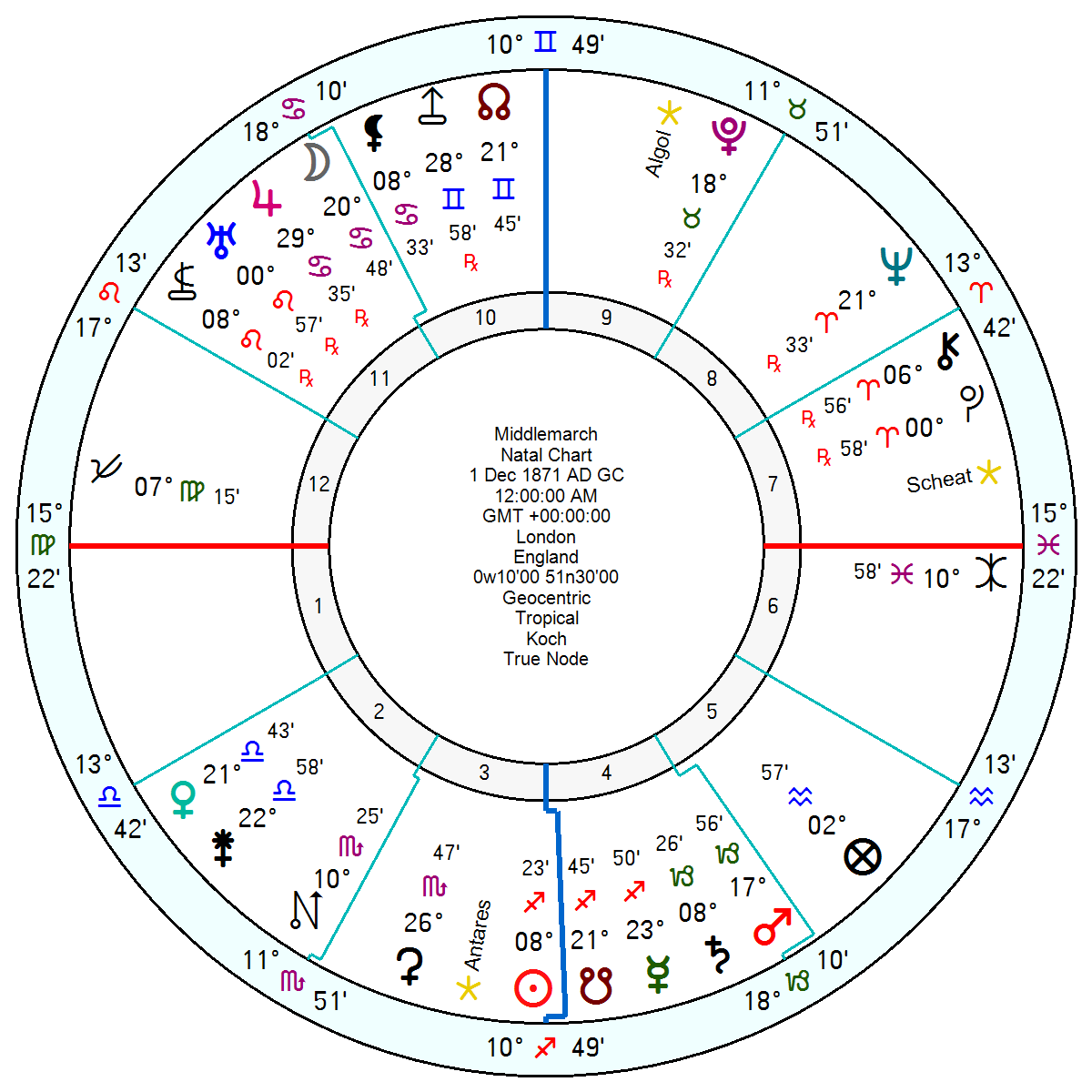
Middlemarch, her second last novel came out in the first instalment on 1 December 1871 when tr Uranus Jupiter were moving through her 9th house of publishing; and oddly tr Pluto was exactly conjunct her Solar Arc Pluto and square her Solar Arc Neptune Uranus. Despite being inordinately difficult, her Pluto Saturn Chiron Scheat square Neptune Uranus must have been what made her great and enduring.
Her Harmonic charts are notable with marked creative 5th and 7th and humanitarian 9th harmonics; as well as the masterly 11H, writers 21H and world-wide reputation 22H.
An extraordinary woman for her time.
The post Middlemarch: an accolade for George Eliot first appeared on Astroinform with Marjorie Orr – Star4cast.