The Death card is the most misunderstood tarot card in the whole deck, and its name still makes people freeze. A woman pulled the Death card and pushed back from the table like it might bite. I asked what she was so afraid of ending. She said her marriage had been over in every way but paper for two years.
However, the Death card has the worst public relations in the whole deck. Yet tarot reflects energy and choice, it does not predict a fixed fate. Breathe. It is a doorway, not a verdict.
Why the Death Card Is the Most Misunderstood Tarot Card
In fact, in the Major Arcana, Death is card 13, the threshold between one shape of life and the next. The archetype is not about panic. It is about compost, pruning, autumn leaves, and the sacred usefulness of endings.
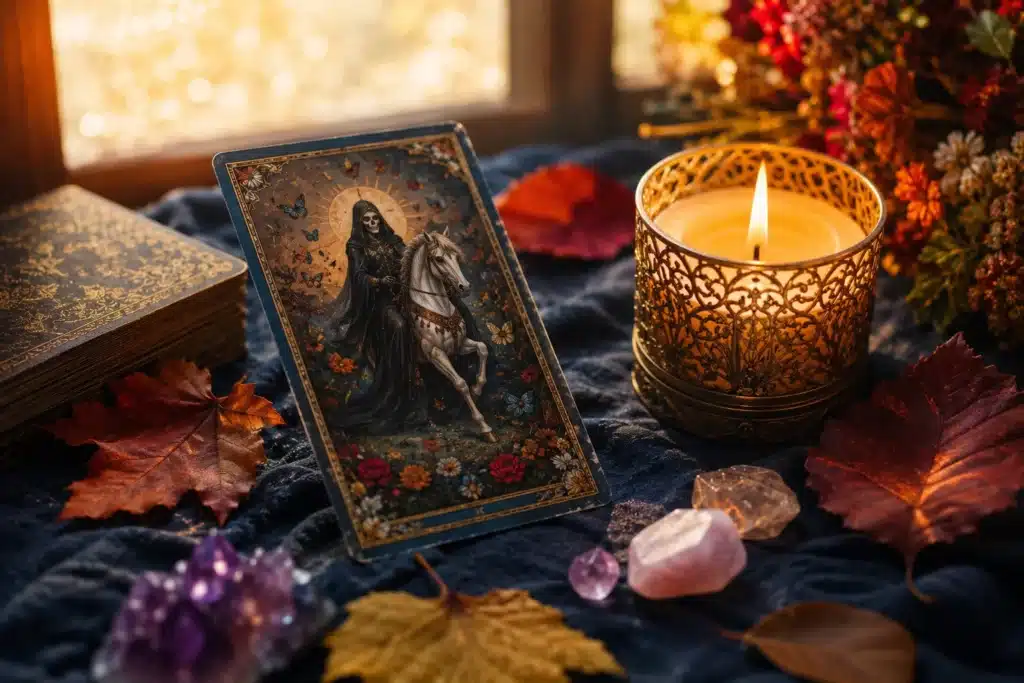
Traditional symbolism indicates closure, release, and renewal after surrender. In Rider-Waite imagery, the skeleton rides forward while a sun rises between two towers. In Marseille decks, the scythe clears the field. Different art, same message: something has finished growing.
This misunderstood tarot card often appears when your aura is tired of pretending. It points to the closet you keep meaning to clear, the text thread you cannot bring yourself to archive, or the role you keep wearing after it stopped fitting.
What People Fear When They Pull It
The horror-movie baggage around the Death card is loud. People see the word Death and imagine danger, doom, or a cruel warning. Here is the cliche-buster: Death does not mean literal death in a responsible tarot reading. It means a chapter closing, not a life.
Still, I will not pretend the Death card is gentle. It asks for the ending you have been avoiding. That may stir grief, confusion, anger, or even strange relief. Many reputable practitioners agree that Death feels intense because it removes the option of denial.
The risk is turning a spiritual message into a trap. If you cling too tightly, the energy stagnates. However, when you name the ending honestly, opportunity can breathe again.
What This Most Misunderstood Tarot Card Actually Means
Upright, the Death card suggests an ending that wants respect. In position meaning, it often describes a relationship pattern, job identity, belief, habit, or old grief reaching its natural limit. This shows tendencies, not certainties.
Its elemental dignity leans toward deep water and fixed earth: feeling meets form. In plain language, your nervous system may already know what your calendar, inbox, or bedroom has not admitted yet. Your choices activate the highest version of this energy.
Reversed, the Death card points to a change stalled. The door is partly open, but the hand stays on the old latch. You may be negotiating with the past, hoping success, love, fortune, or safety can arrive without any release at all.
During the window from July 17 to July 23, 2026, a soft Mercury retrograde tone may favor review, closure, and unfinished conversations. Use that energy gently. No dramatic performance is required.
What It Wants You to Do
So the card wants one quiet action: let one thing end cleanly enough that the next thing can arrive. Not everything. Not your whole life. One honest release.
Ask three questions before you react:
What am I keeping alive only through guilt, habit, or fear?
What would feel like relief if I stopped forcing it?
What small blessing might enter if I made space for it?
According to classical tarot frameworks, the Death card rarely asks for chaos. More often, it requests a boundary, a final box packed, a letter not sent, a subscription canceled, or a truth spoken without cruelty.
This is where victory becomes humble. You do not defeat the old chapter by hating it. You thank what the Death card taught you, then stop feeding what is finished.
Where the Death Card Sits in the Bigger Story
Death never travels alone. It is one station on a longer road, and it reads differently once you follow the symbolic path inside a tarot deck from the Fool at the start to the World at the end. Seen that way, card 13 is not a dead stop. It is the turn where the path bends toward something you cannot see yet.
The sky tells a similar story. This misunderstood tarot card rhymes with Saturn, the old teacher of endings, limits, and slow maturity, so it helps to notice how Saturn cycles push and stall your life when a chapter refuses to close on your preferred timeline. Saturn does not rush, and neither does Death. Both ask for proof that you are ready to let the old shape go.
Here is the mercy hidden in it. What you release does not simply disappear. It changes state, the way heat becomes light, which is the quiet mechanic behind manifestation and how energy actually moves once you stop feeding what is already finished. Endings are not the opposite of creation. They are the first, unglamorous half of it. Every seed that ever grew had to break open in the dark before it counted as a beginning.
A Small Ritual for Letting Go
Do this simple release practice within 48 hours of pulling the Death card, or whenever the message feels alive. Keep water nearby if you use flame, and choose a fire-safe bowl or outdoor earth if you bury the paper instead.
Write one sentence beginning, “I release my attachment to…” Be specific.
Fold the paper away from you 3 times.
Burn it safely, or bury it at the base of a sturdy tree.
Light a candle for what comes next, using white for clarity or green for growth.
Sit for 7 breaths and notice what your body softens around.
For extra lunar wisdom, remember the Moon, whose endings and renewals repeat every month. Nature never shames the leaf for falling.
The Death card does not arrive to frighten you. It arrives when your spirit is tired of dragging bones through new doors. Save this reading, share it with someone who fears the Death card, and return to it when an ending begins to feel like mercy.
The post The Most Misunderstood Tarot Card (And What It Actually Wants You to Do) appeared first on askAstrology.