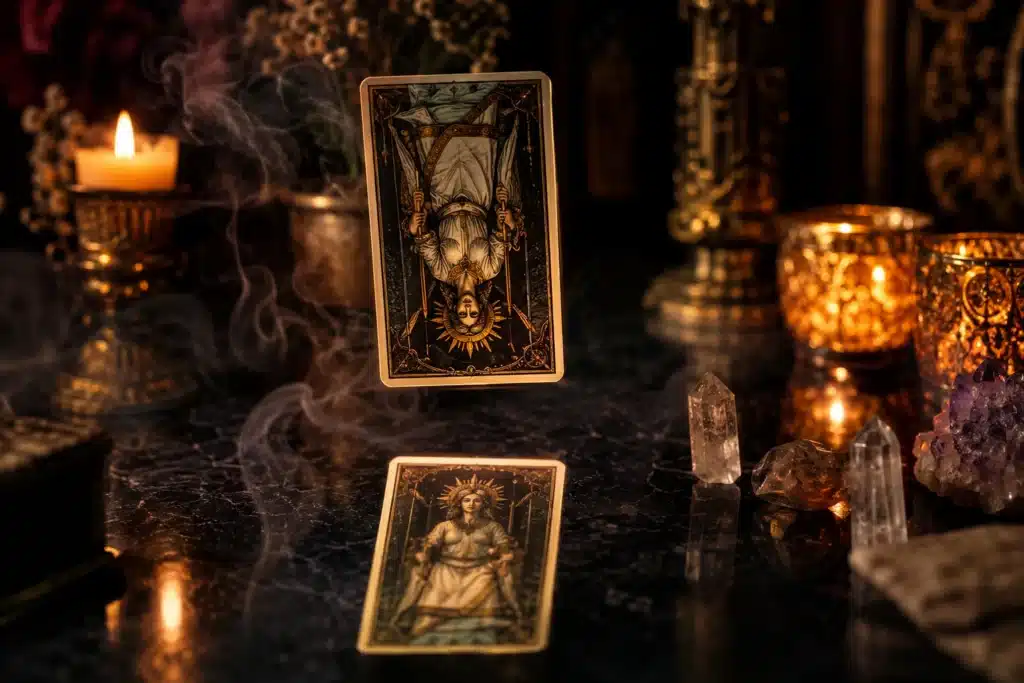
Reversed tarot cards can make even calm seekers suddenly hold their breath. A man once pulled three reversed cards in a row and went pale. I turned the reading around for him. The reversals were showing him where his own energy was stuck, all internal, all fixable. Upside down does not mean it went wrong. It means look inward. On July 25, with Mercury recently direct after July 23, this is a lovely moment to revisit what once felt blocked.
Why Reversed Tarot Cards Scare People for No Reason
Let us name the fear first. Many people see reversed tarot cards and think, “Bad luck.” They imagine The Lovers reversed means love is doomed, or The Sun reversed means happiness has vanished.
But tarot is more subtle than that. It speaks in symbols, shadows, seasons, and choices. A reversed card is not a curse flipped face down. It is usually the same lesson speaking more quietly.
The old cliche says reversed cards always mean the opposite. I do not read them that way. More often, they soften, block, delay, or turn the meaning inward.
If you want a wider view of tarot symbolism, explore the layered symbolism inside a tarot deck. Every card holds many meanings, and reversal is only one of them.
What It Actually Signals
Upright means the card appears in its usual position. Reversed means it appears upside down in the spread.
That reversal may point to energy that is not flowing cleanly yet. Fear, timing, or old habit may be holding it back, hiding it, slowing it down, or keeping it half-formed beneath the surface.
Think of the Moon, whose light we only ever see reflected. A reversed card can work like moonlight on water. The message is present, but it asks for softer eyes.
So, instead of asking, “Is this bad?” ask, “Where is this energy trying to move?” That one question changes the whole reading.
In the readings I have given over the years, reversed tarot cards are almost never the frightening ones. Because an upright card can flatter you, while a reversal tends to name the part you already suspected but had not said out loud. That is why people flinch. Not because the card is cruel, but because it is quietly, inconveniently accurate.
Blocked energy: something wants motion, but fear or timing slows it.
Internal energy: the lesson is happening inside you first.
Delayed energy: the card is active, but not fully visible yet.
Softened energy: the upright meaning still applies, just less loudly.
The Real Messages Behind Reversed Tarot Cards
Reversed tarot cards are often invitations to be more honest with yourself. They do not shout from the altar. They tap at the inner door.
Blocked or internalized energy means the card is asking where you are holding back. The Chariot reversed may not mean failure. It may mean your willpower is scattered. The Queen of Cups reversed may ask whether you are caring for everyone except yourself.
A gentler, slower version of the upright card is just as common. The Ten of Cups reversed, still about home and love, just asking whether yours lives up to the picture you show people. The Ace of Pentacles reversed may suggest an opportunity that needs grounding before it grows.
A reversed Three of Swords can mean grief that is finally starting to heal, rather than fresh heartbreak. Meanwhile, the Devil reversed often shows someone loosening a chain they once believed was permanent. Reversed tarot cards frequently mark the exact moment a hard thing begins to turn, quietly, long before anyone else can see it.
This is also where manifestation and how energy actually moves can help. Tarot reflects energy and choice, not fixed fate. You are not trapped inside the card.
Should You Even Read Them at All?
Not every reader uses reversals, and that is valid. Tarot is a language, speak your own dialect.
Some readers shuffle only upright cards and rely on position, intuition, and surrounding cards for nuance. Others welcome reversals because they add texture, like moss on stone or wind under a raven’s wing.
There is no wrong answer. If reversals make your readings cloudy, leave them out for a while. If they add clarity, keep them. The deck is a conversation, not a test.
Cycles matter too. Sometimes life stalls before it strengthens, much like how Saturn cycles push and stall your life. A reversed card may simply say, “Patience, little flame.”
How to Work With One Instead of Fearing It
Here is a calm method for reversed tarot cards. First, read the upright meaning. Then ask whether that meaning is blocked, internal, slowed, or softened.
Name the card’s upright theme in one plain sentence.
Ask, “Is this energy blocked by fear, timing, or habit?”
Ask, “Is this happening inside me before it appears outside?”
Notice nearby cards for support, pressure, or advice.
Choose one grounded action, such as journaling, resting, apologizing, planning, or asking for help.
For example, Strength reversed may not mean weakness. It may simply mean your courage is tired and quietly asking for rest. A Hanged Man reversed can say that you are still resisting a surrender you already know is coming. And the Star reversed may whisper that your hope needs gentle tending, not forcing.
Gentle safety note: if a reading makes you anxious, pause, breathe, eat something, and return later. Remember that how the stars shape your mental health matters far more than any single card. Tarot should help you feel more present, never more afraid.
Above all, meet reversed tarot cards with curiosity instead of dread. Because a card read in fear will only ever answer your fear. A card read with an open heart, however, tends to answer the real question sitting underneath it.
Reversed cards are not enemies in velvet cloaks. They are quiet messengers, asking you to face the place where energy hesitates. So next time one appears, do not flinch. Turn inward, listen closely, and let the card show you the next honest step.
The post Reversed Cards Aren’t Bad. Here’s What They’re Really Telling You appeared first on askAstrology.