The Death card meaning is the single most misread idea in tarot, and after twenty years of reading I have stopped being polite about it. Card thirteen is not a warning. It is a receipt. When it lands on the table, something has already ended, and the card sitting next to it carries the actual instruction. Still, the skeleton gets all the attention.
The Death Card Meaning People Get Wrong
I still get a small jolt when it comes up. Twenty years in and my hand still hesitates for half a second. The image is doing its job, honestly, and I would be suspicious of any reader who claims total calm.
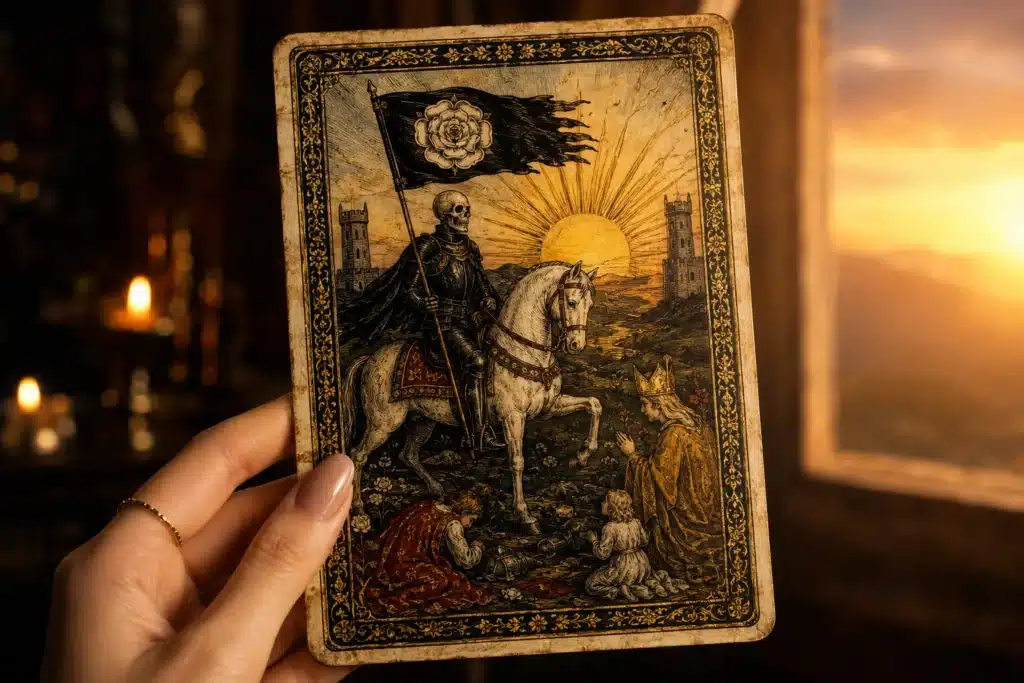
Look at what is actually painted there, because the Death card meaning starts with the picture. A skeleton in armour. A white horse. Then a fallen crown in the dirt, a black banner with a white rose, and a bishop standing his ground while a child holds out flowers. Those are medieval symbols of rank collapsing, not a threat. However, cinema arrived in the twentieth century and needed a shorthand for doom, so the horror film version of the Death card stuck because fear travels faster than nuance ever will.
Here is the cliche I refuse to repeat. Readers love to say “Death never means literal death,” and while that is technically true, it is also a dodge. The Death card meaning is a real ending. Real endings hurt even when they are correct. Therefore I never pat a frightened client on the hand and pretend nothing serious is happening in her life.
Why the fear stuck so hard
Numbering did not help. Thirteen already carried centuries of superstition before tarot borrowed it, so major arcana thirteen inherited a reputation it never earned. Eden Gray, the writer who put modern tarot into plain English for American readers in the 1960s, described this card as a transition rather than a literal ending, and that framing is still the sanest one available. Most of the panic in my inbox comes from people who have seen the card in a film but never in a spread.
What Card Thirteen Actually Shows
The Death card is the most administrative card in the deck and I will defend that position anywhere. It is a form being filed. It is not a scythe. Notably, the Death card meaning describes a status change, the way a registry office describes one.
Think about the objects involved. A lease. The title deed. Somebody’s name coming off a joint account. The resignation letter that sits in drafts for eleven days before anyone clicks send. The Death card meaning is the paperwork of a life reorganising itself, and paperwork is dull precisely because it is final.
Because that sounds abstract, let me put a real face on it. I turned Death over for a man in his sixties once and watched the blood leave his face. He thought I was going to tell him about his heart. What the spread actually said was that the shop he had run for thirty one years was finished, and he already knew, because the lease renewal was sitting unsigned on his kitchen counter. Not just unsigned, either. It was the envelope he had moved from one pile to the other every week for two months. When I said the word “shop” instead of the word he was dreading, he laughed, then he cried, then he went home and signed nothing at all. That is exactly what card thirteen looks like in daylight.
So the card catalogues. It does not sentence. If you have ever wondered why some cards get an unfair reputation, the same mechanism is at work across the cards readers wrongly call negative, where the picture frightens people long before the meaning gets a hearing.
Why the Death Card Meaning Is Usually Good News
Card thirteen does not decide anything. It notices. That distinction is the whole reading, and once a client hears it, her shoulders drop about two inches.
The Death card meaning feels brutal because it names something out loud after months of quiet denial. Instead of arriving to break your life, though, it usually turns up well after the inner decision has already been made. You changed your mind in March. The card simply catches up in September and asks why the paperwork is still pending.
That is where the relief lives. Your deeper self has already stepped away from whatever was draining you, so the reading confirms a door you have been staring at for a long time. Meanwhile the useful information sits one position to the right. Death with the Star points toward repair and hope. Card thirteen followed by the Eight of Pentacles says learn the new skill, seriously, sign up this month. Death before the Six of Swords says leave cleanly and stop renegotiating.
Clients often ask whether the card can be gentle. It can, and I have written elsewhere about how this card can help you live rather than scare you, which is closer to my daily experience at the table than anything the horror version suggests.
Scorpio, Pluto and the Astrology Behind It
In the Golden Dawn correspondences that most modern decks inherit, card thirteen belongs to Scorpio, fixed water. Fixed means steady, dug in, hard to shift. Water means feeling, memory and the emotional sediment that settles at the bottom of the cup, so the pairing describes an ending held quietly for a long time before anyone admits it.
Scorpio does not do half endings. It knows in the bones when a thing is finished, which is why readers link this sign to the eighth house of shared resources, inheritance and everything that gets legally untangled when two lives separate. Pluto lends the colder logic. Astronomers reclassified the small distant world named after the god of the underworld as a dwarf planet in 2006, and astrologers kept reading it anyway, because its symbolism of buried pressure and forced disclosure did not change with the label.
Seasonally, the association gets loud between late October and late November. Readers who work with that window often explore the Scorpio season link to rebirth and release, when clients start booking sessions about endings they have been circling since summer.
How the Death card meaning differs from the Tower
People confuse the two, although they behave nothing alike. Card sixteen is sudden, external and loud. Major arcana thirteen is slow, internal and quiet, more filing cabinet than lightning strike. If the shock version is what you actually pulled, read up on the other card everyone dreads pulling instead, because the advice is genuinely different.
What to Do the Week You Pull It
First, look at the next card. Not vaguely, closely. If Death is the stamp, the following card is the instruction. The Knight says move. A Hermit beside it says withdraw instead. The Two of Pentacles says simplify before you add anything new. Pull the Ace and you begin, but begin small.
Then do the unglamorous part, which nobody posts about. Cancel what you no longer mean. Stop defending the version of yourself that made sense five years ago. Clear one drawer, answer one email, move one name out of one place where it no longer belongs. Small, boring, irreversible.
Honestly, I am not certain the ritual below does anything cosmic. What I do know is that clients who try it stop spiralling, probably because a plain sentence is harder to catastrophise than a vague dread:
Write the ending in one plain sentence, with no poetry in it at all.
Place card thirteen beside the card that follows it and read them as a pair.
Ask yourself what the real next step is, then name a deadline.
Blow out one candle before sleep and let the dark be honest with you.
Finally, keep three things in mind about the Death card meaning when it turns up again. Card thirteen is paperwork for the soul rather than a threat. The fear you feel is real, but it is not the message. Above all, the card beside it is the compass, and most readers spend far too long staring at the skeleton to notice it.
That is why pulling this card can be good news. It does not flatter you, yet it respects you enough to say the true thing. Death in tarot names the ending you already feel, then hands the reading over to the next card, where the choice actually lives.
The post The Death Card Is Not What You Think (And Why Pulling It Is Actually Good News) appeared first on askAstrology.