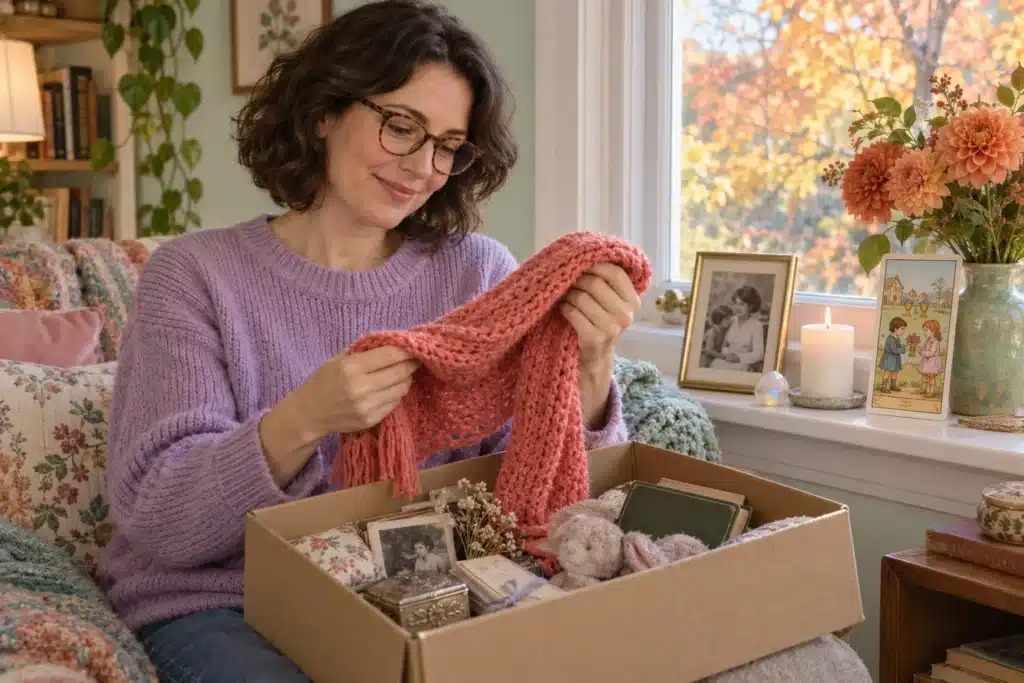
Sentimental clutter begins quietly, because the object is rarely the real problem. It is the hand that gave it, the room it came from, the birthday dinner, the apology, the goodbye, or the love you still cannot sort into a neat little pile.
A keepsake becomes heavy when it asks for shelf space long after its usefulness has ended. This is perspective, not prediction. Still, if you have ever stared at a vase, a sweater, a mug or a card and thought, “I cannot get rid of this,” you are not shallow. You are human. What would change if the memory did not need the object to survive?
Sentimental Clutter Is Never About the Object
Sentimental clutter is usually about the giver, because gifts are never emotionally neutral. In 1925, the French anthropologist Marcel Mauss published The Gift, about how, in many societies, a gift creates a bond and an obligation to give back. That old idea still sits in modern closets, and you can read more about why gifts have always come with strings.
So when you hold the chipped mug from your aunt, you may not be holding ceramic at all. You may be holding gratitude, duty, family history and the fear of seeming cold. Meanwhile, the mug is silent. Your heart is the noisy thing.
It is just a thing. That sentence can feel rude at first, yet it lets air into the room. Most sentimental clutter stays put because releasing it feels like voting against the giver.
I do not believe releasing a gift proves love was absent. Love is larger than storage. Guilt, though, is a clever little landlord, and it charges rent in drawers, basements and nervous glances toward the closet. Keeping something out of guilt is not loyalty. It is rent you pay to a memory.
If you want another tender angle on why some people struggle to let go, notice how often attachment disguises itself as responsibility. Responsibility can be kind without being endless.
The Gift From Someone You No Longer Speak To
Old gifts from exes and former friends carry a special sting, because they hold a version of you that no longer answers the phone. There is the necklace you never wear, the cookbook from the apartment you left, the framed print from someone who knew your favorite color before they knew how to stay.
Distance changes the contract. A gift given in tenderness does not have to become a lifetime command. After a relationship ends, though, sentimental clutter can turn one object into a case you keep reopening every time you open the cupboard.
For six years I kept a bread maker that a former partner gave me for my thirtieth birthday. I used it twice. Every time I moved, I packed it, carried it, and put it back in a cupboard. Last spring I finally wrapped it in a towel, said thank you out loud like a fool, and gave it to a neighbor who bakes. She sends me a photo of every loaf. That is the best use it ever had.
That bread maker taught me something plain. The gift had already done its work, marking a birthday and a hope. Keeping it unused did not honor the relationship. It froze it inside a cupboard.
Before you release a gift from someone you no longer speak to, ask one careful question: am I keeping this because it still serves my life, or because I am afraid to admit the bond changed? There is no shame in either answer. Some items deserve a longer pause, like a birthday card still sealed in its envelope, the stamp never postmarked. Sort slowly.
The Things You Keep for Someone Who Is Gone
Grief makes sentimental clutter sacred, complicated and tender. While ordinary decluttering says “use it or lose it,” grief whispers, “Please do not make me lose another thing.” I listen to that whisper with respect.
When someone is gone, their objects can feel like the last visible proof that they touched the world. A scarf still smells faintly like a hallway. A recipe card holds pressure marks from a hand you miss. Not every object has to become a monument, though.
If you are grieving, go softer than soft. Start with what carries little ache, like duplicate kitchen tools or old mail, and leave the hard box alone until your body stops bracing.
I still have a drawer I do not open. I am not ready, and I have decided that is allowed.
That is not failure. It is pacing. In my experience, honoring someone becomes more nourishing when sentimental clutter turns into a chosen place instead of a scattered one. You might create a small altar for someone you have lost, or a single shelf with a photo, a ring dish and one letter. Which would feel more loving: five boxes you avoid, or one space you can approach with breath?
Keep the Story, Not the Shelf
The shelf is not the story, and the box is not the bond. One of the gentlest ways to reduce sentimental clutter is to move the meaning into a smaller, clearer container.
Take a photo before donating the lamp. Write three sentences about the sweater before folding it into a bag. Save one letter instead of every envelope.
Photograph the item in natural light and write down who gave it.
Keep one representative object from a season, not the entire season.
Give small keepsakes a single labeled box, so memory has a border.
Write a note that begins “This mattered because…” before you release it.
I’ve helped two friends do this after a parent died, and both kept fewer things than they expected and loved them more. Sentimental clutter shrinks fastest when you choose the object that tells the truth best, rather than the one that makes you feel most guilty.
Some people like to time small clear-outs with the seasons. For a reflective nudge, you may enjoy the September new moon that asked us to clear a shelf, not as a rule, but as a reminder that homes breathe better when they are tended gently.
How to Let Go of Sentimental Clutter Without Guilt
Sentimental clutter softens when you stop treating release like betrayal. You can let an object leave with manners. That may sound strange, but a small ritual gives the heart a handle.
First, hold the object and say who gave it to you.
Then say one honest sentence about what it represented.
Next, say “Thank you for what you carried.”
Choose its next place: donation, return, repair or the keepsake box.
Finally, wash your hands, open a window or make tea before moving on.
This is not magic. It is a pause, and when you mark an ending, guilt has much less to grab.
Keep what still feels alive to you, and release what only proves you are dutiful. If all you do this week is hold one object, say thank you and decide where it goes, that counts as a real beginning.
The post You Cannot Throw It Away Because of Who Gave It to You appeared first on askAstrology.