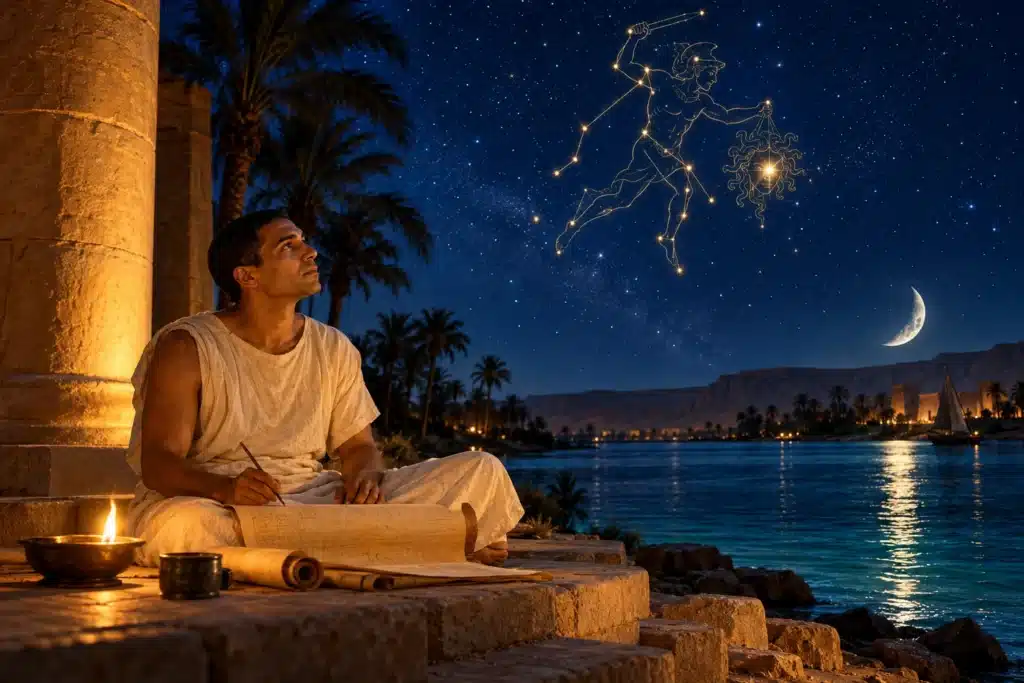
More than 3,000 years ago, an Egyptian scribe gave each day three omens, favorable or unfavorable. A modern statistical analysis claims that a cycle of 2.85 days hides in these verdicts, precisely the supposed length of Algol’s changes in brightness at that time. That turns the Cairo Calendar into a test case, because astronomy, myth, statistics and astrology all end up sitting at the same table.
Here is the real question. Does the papyrus encode someone’s observation of a variable star, tied to the god Horus, or did modern researchers find a chance rhythm, after the fact, inside a dense set of myths? A pattern in an old text earns curiosity now and belief much later. I’m hoping for the revelation, yes. I also want the evidence to survive daylight.
The Cairo Calendar and Its Good and Bad Days
The Cairo Calendar, usually identified as papyrus Cairo 86637, is Ramesside, probably 1244 to 1163 BC. Its structure is simple and strange: three verdicts written for every single day of the year, each one favorable or unfavorable. Read in order, the text works like a ritual weather report for the whole year.
The stories attached to the verdicts in the Cairo Calendar matter. Horus appears, Seth appears, and so does the wedjat eye, the eye of Horus that was injured and restored. So the manuscript already speaks in symbols before any modern calculation begins.
It gives days a quality, a little like a modern list of favorable days, with divine stories woven into the timing. If you want background on how Egyptian priests read the sky, keep one distinction sharp: this papyrus gives verdicts first. Any pattern comes later, from us.
I reject the cliche that the ancient Egyptians had a secret astronomy we have lost. The living question is leaner, and stronger. Did ritual time, mythic time and observed sky time sometimes meet on the same page?
Two Rhythms Hidden in the Verdicts
The astronomer Lauri Jetsu and his colleagues ran periodicity analyses on the favorable and unfavorable sequences of the Cairo Calendar. They report two main cycles. One is about 29.6 days, close to one lunation, the Moon’s cycle of phases. The other is about 2.85 days, near the period Algol would have had three thousand years ago. Two numbers. Three thousand years.
This is where a list of lucky and unlucky days starts to hum. Instead of reading each omen as isolated advice, the analysis treats the verdicts as data points. After that, the tests ask whether the sequence repeats more often than chance would allow.
Imagine tapping a desk at irregular moments, then discovering a metronome hidden under the room noise. However, statistics can sharpen confusion as easily as they reveal order, especially in a text as rich as the Cairo Calendar, tested many ways.
I once watched a variable star from a folding chair, sure it was fading every few minutes. Near midnight I saw I had compared it with the wrong neighbor all along. I crossed out ‘pattern found’ in my notebook. That line is why this papyrus fascinates me.
The Moon, and a Star That Blinks
Algol sits in Perseus and carries the old nickname Demon Star. On older maps it marks Medusa’s head, which is why the gorgon myth tied to that star still clings to it.
In plain words, Algol is an eclipsing binary. Two of its stars pass in front of each other from our line of sight, so the combined light dips, then recovers. For a clean reference on the eclipsing star in Perseus, remember the mechanism: one star blocks part of the other’s shine, again and again, on a schedule.
Jetsu and his colleagues link the Horus passages of the Cairo Calendar to Algol and the Seth passages to the Moon. You can see why the pairing tempts. Horus is the god whose eye is damaged and made whole again, and Algol visibly loses its light and gets it back. Seth, his rival, brings conflict and disorder into the stories, and the Moon goes through its own loss and return with every lunation.
A star that dims and recovers on a timetable would make a fine omen engine. I don’t know if a scribe ever looked up at Algol. I’d love to.
Why the Evidence Is Still Debated
Strip the claim to its honest version and it stays modest. The Cairo Calendar exists, and the statistical regularities are established. The star reading is a published, argued hypothesis, and historians have not settled it. One of the papers even carries the word ‘Confirmed’ in its title, which says more than the data allow.
First, no passage names Algol. That silence matters. Second, no text shows anyone watching the star, timing it or comparing it with its neighbors. Third, the cycles’ starting point is not in the manuscript, so modern hands have to choose it. A cycle without an ancient anchor can slip.
Fourth, the links between gods, omens and star phases are interpretation. Horus may fit Algol elegantly, and Seth may fit the Moon, but elegance can become a trap. A symbol can attract more meaning than the source can carry.
When I first read the study, the note I wrote in the margin was about that starting point. Move it a few days and does the match hold? I’ve learned to ask that question of every neat cycle, my own included. There is also a quieter risk here: we may want ancient confirmation for modern wonder, and wanting it can bend how we read.
Five Ways to Read the Cairo Calendar
Read astronomically, the verdicts encode sky rhythms, the Moon at about 29.6 days and Algol near 2.85 days. Observers would have noticed the star’s regular dimming and turned it into religious stories. It is the most electrifying option, because a changing star would have entered the calendar as living timing.
A calendrical reading sees a ritual rule instead, a priestly schedule for assigning good and risky days. In that case, the rhythm belongs to temple practice, with no star required.
Statistically, a rich text can be tested many ways, and some patterns will look exceptional after enough attempts. That does not erase the result. It simply asks how many regroupings and shifts came before the rare one.
A mythological reading lets Horus, Seth and the wedjat eye drive the pattern through story logic. Conflict, injury and restoration repeat because the myths repeat them, and story can order time as firmly as observation.
Finally, traditional astrology reads the calendar as sky rhythms giving days a quality, with no proven effect on events. Try a small version tonight. Choose one visible star, compare it with one neighbor, and write one plain sentence about its brightness. Repeat on a few clear nights, then notice your own hunger for pattern.
The Cairo Calendar leaves us on the threshold between omen and observation. Maybe ritual order or mythic repetition made the pattern. Or maybe it happened the way the scribes’ world worked: a star changes, a god acts, and a day becomes lucky or dangerous.
The post This 3,000-Year-Old Papyrus Seems to Track the Eclipses of a Star appeared first on askAstrology.