Samhain and Halloween share October 31, but they do different work. One names a Gaelic turn of the season, with winter stepping in at sunset. The other names a Christian vigil before All Saints. Because both gather masks, lanterns, ancestors and doorways, people blur them fast, and I’ve watched that blur cost readers real meaning. With Halloween two days away, let’s separate the bones from the candy.
Samhain and Halloween Share the Same Night
Same night. Different current. Samhain and Halloween meet on the evening of October 31 because the old Celtic day began at sunset. So the festival of November 1 opened the night before, as the Sun went down and the darker half of the year took over.
Halloween gathers on that same evening through a Christian calendar. All Hallows’ Eve means the night before All Saints. The overlap is real, and the confusion is understandable. However, calling Samhain ‘pagan Halloween’ flattens two traditions that each deserve a night.
At a Halloween party years ago, I called Samhain ‘the witches’ Halloween’ and an Irish guest kindly corrected me. Her grandmother used the word for the whole month, the way you would say November. I read until two in the morning that night. I have not used that phrase since.
That correction stuck because it was precise. When you name a thing cleanly, you stop dumping every October shadow into one plastic cauldron. Drop the cliche that Halloween is simply Samhain with candy. It is lazy history, and lazy history makes lazy practice.
What Samhain Meant to the Gaels
Samhain is a Gaelic festival on November 1. It marked the end of the harvest, the start of winter and the darker half of the year. In Irish and Scottish Gaelic, Samhain is also simply the name for November. That alone should slow the hot takes.
The earliest Irish literature, from the 9th century, treats Samhain as a threshold time. A threshold is a crossing point, the moment one condition gives way to another. Autumn hands the keys to winter, light retreats, and stored food and kinship become serious business.
At Samhain, the Otherworld felt close. In the old stories, that meant an unseen order brushing against ordinary life. Bonfires were lit. A place set at the table for the family dead kept memory in the room, with discipline. Then there was guising, going door to door in costume, which belonged to the season from at least the early modern era.
For sturdy background on the festival’s older Gaelic history, stay with the Gaelic frame first, then compare Samhain and Halloween second. The logic is practical: harvest ends, winter begins, and the community’s habits tell the body what the sky already shows.
Where the Word Halloween Comes From
Halloween comes from All Hallows’ Eve. A hallow is a holy one, and the eve is the night before. Therefore, Halloween points to the vigil before All Saints on November 1. The word carries church-calendar DNA, even when the modern street wears glitter fangs.
The Frankish Empire adopted November 1 for All Saints in 835. That date anchors Halloween in Christian remembrance as much as in folk custom. After that, All Souls on November 2 followed in the 11th century. Together, October 31, November 1 and November 2 formed three linked days of attention to the holy dead and the remembered dead.
I’m strict about this part, so be exact. Samhain names the Gaelic season turn on November 1, beginning at sunset on October 31. Halloween names All Hallows’ Eve, the evening before All Saints. Samhain and Halloween touched where calendar, weather, story and household habit met, and scholars suggest that many Halloween customs were influenced by Samhain.
Still, a braid has strands. Yank them into one rope and you lose the texture. Sloane rule: if the lore gets mushy, the reading gets mushy.
From Carved Turnips to Pumpkins
Turnips came first.
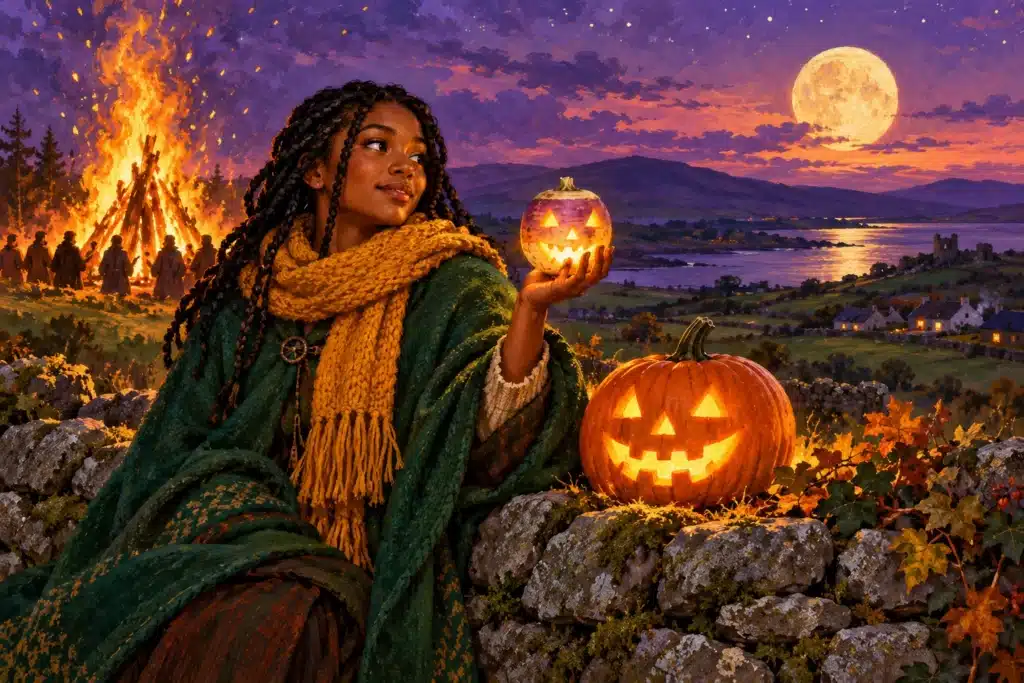
In 19th-century Ireland and the Scottish Highlands, carved turnip lanterns were common: hard, humble and eerie in the hand. In the 20th century they became known as jack-o’-lanterns. When pumpkins take over a porch now, they carry a later look with older lantern logic underneath.
I’ve carved a turnip lantern exactly once, for a client who wanted her October done the old way. It took me most of an hour, a grapefruit spoon and nearly all my patience. The glow was tiny and frankly unsettling. I understood immediately why pumpkins won.
Guising crossed over too. Halloween later gathered doorways, disguises, lanterns and neighborhood theater into a louder public style. Because customs travel with migration, religion and weather, simple origin stories crack fast. How much of trick-or-treating is Gaelic? Scholars still argue. I won’t pretend to settle it.
Here is the clean map:
Samhain: a Gaelic festival on November 1, beginning the evening of October 31.
Halloween: All Hallows’ Eve, the night before All Saints.
Shared ground: costumes, lanterns, the dark season and remembrance of the dead.
Open question: how much each custom owes to Gaelic roots, which scholars offer as a suggestion.
For the wider seasonal wheel, compare Samhain with the eight festivals of the pagan year, and look back to the equinox festival that comes before it.
Keeping Samhain and Halloween in 2026
Samhain and Halloween in 2026 ask for one clean move: let each date speak in its own voice. On October 31, enjoy Halloween if you want the masks, candy and social voltage. On November 1, keep a quieter Samhain if that fits your path. No performance required.
Because this is AskAstrology, we also watch the sky. The astronomical midpoint of autumn arrives when the Sun reaches 15 degrees Scorpio, and in 2026 that happens on November 7 at 4:52 a.m. Eastern. The Sun’s transit through Scorpio, a fixed Water sign, is the stretch of sustained emotional depth. In other words, the season keeps building after the candy wrappers hit the trash.
The calendar lines up neatly. October 31 opens the cultural gate. November 1 carries the Gaelic name and the old seasonal weight, November 2 holds All Souls, and November 7 marks autumn’s solar midpoint by degree. The energy keeps going well past midnight.
If you want contemporary practice, read how modern witches mark the night. Here, the job is historical precision. Keep the candy with Halloween, and keep Samhain tied to the harvest’s end, winter’s start and the darker half. When someone says they are the same, correct them kindly. They share a doorway, and each one walks through it in its own clothes.
The post What Is Samhain, and How Is It Different From Halloween appeared first on askAstrology.