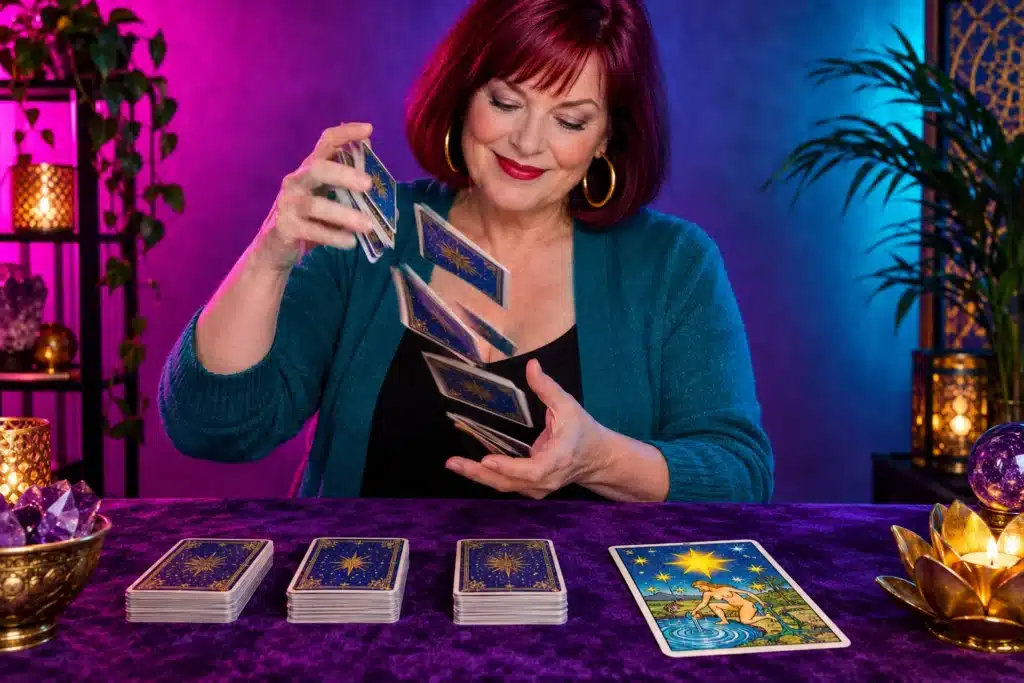
When shuffling tarot cards, many readers stop at three shuffles because the count gives their hands, mind and question a clear place to meet. Three has little to do with strict chance. It buys focus, a breath and a small pause before the spread begins, which is why the habit matters even when the cards are far from fully mixed. The shuffle sets the reading space, and your free will stays firmly in charge.
Shuffling Tarot Cards Three Times Is a Ritual First
Shuffling tarot cards three times works like a doorbell for attention. You ring it, pause and step into the reading with less mental noise. Because tarot runs on symbols, stories and personal meaning, the way you begin shapes how clearly you listen.
A ritual is a repeated action that helps the mind shift into a set state. After a busy day, that small pattern is useful. You hold the deck, name the question and let your hands do something steady.
Many readers connect three with past, present and future. Others link it to question, card and answer. Either way, the count becomes a simple frame that gives the reading a clean start, and nobody enforces it.
The first reader I ever watched shuffled exactly three times, tapped the deck twice and cut it into three piles with her left hand. I asked why. She said, ‘Because that’s how I know I’m listening.’ I tried it at home the next night with a deck still stiff from the box and sprayed half the Minor Arcana across the floor. Three times was plenty.
What Mathematicians Say About Shuffling
Here is the practical part. Mathematicians Dave Bayer and Persi Diaconis analyzed riffle shuffling and concluded that a standard 52-card deck does not start to become random until about five good riffle shuffles, and is truly random after seven. The ‘seven shuffles’ answer dates from 1990.
Seven, said the math.
Shuffling tarot cards raises the stakes, because a tarot deck has 78 cards: 22 Major Arcana and 56 Minor Arcana. So three shuffles cannot fully mix even a 52-card deck, let alone a tarot pack. In a reading, their job is focus, and that is fine.
If your shuffle has to be perfectly random, you are playing poker. Tarot uses chance, and it also uses context, symbol and attention. Probability is the study of how likely events are, and you can read more about the math of chance if the numbers interest you.
Math and meaning can sit at the same table, so you do not need to pick a side. The cards get mixed a little, your mind gets steadied a lot, and the question gets a clear start. This offers perspective and predicts nothing.
Why the Number Three Keeps Showing Up
Three shows up in tarot because it is easy to feel and easy to remember. A three-card spread gives a beginning, a middle and a next step. It can also show mood, challenge and advice. Because the form is small, beginners can read it without drowning in detail.
Cutting the deck into three piles with the left hand is another common habit. The left hand is often linked with intuition, meaning inner knowing. However, no fixed rule makes the left hand more spiritual than the right. It is a custom, and customs gain power through use.
Repeat a count often enough and your body learns the rhythm. The thumb lifts, the fingers square the deck, and the breath slows. Shuffling tarot cards becomes a quiet metronome for the reading.
Three gives me enough time to arrive, which is why I like it. I can’t prove three is better than four. I just know when I’m done. Still, I reject the idea that there is one correct way to shuffle tarot. That belief makes new readers tense, and tension makes the hands clumsy. Use three when it helps, and adjust when it does not.
Riffle, Overhand or Wash: Pick Your Shuffle
When shuffling tarot cards with a riffle, you bend each half of the deck so the cards fall together. It mixes well when done cleanly, but it is hard on card stock. With a new deck so stiff the cards bow when you riffle them, the move feels like wrestling a small wooden door.
The overhand shuffle is gentler. You hold the deck in one hand and pull small packets into the other. Because tarot cards are often larger than playing cards, this style feels safer and more natural, and it works well at a small table.
The wash spreads the cards face down across the table, and you move them around with flat palms before gathering them back. This method mixes direction as well as order. That is why washing turns up more reversed cards: some cards rotate while your hands move them around.
A reversed card appears upside down from the reader’s view. Some readers read reversals as blocked energy, while others read every card upright. Choose your system before you start, because changing mid-reading muddies the answer.
I’ve retired the riffle for my oldest deck after its corners started to curl. These days I wash it on a cotton scarf and finish with three overhand passes, which keeps my count and spares the card stock. If you are getting a new deck ready for its first reading, test each style slowly and notice which motion keeps the cards safe and your hands calm.
Finding Your Own Way of Shuffling Tarot Cards
Finding your own way of shuffling tarot cards starts with a simple choice. Pick a number and keep it for a while. Repetition builds trust, so your body will start to know the reading has begun. Three is popular, yet your practice may settle somewhere else.
Decide what you will do when a card jumps out. A jumping card slips or flies from the deck during the shuffle. Some readers treat it as a loud note, and others put it back and keep going. What counts is consistency, so make that choice before the question gets emotional.
Once you name the question, shuffle until the question feels asked. That phrase sounds soft, yet it is practical: your mind moves from scattered to direct, and you can feel the moment it lands. Stop when you feel present. Pressure is a bad timer.
If you need a simple topic, try a clear daily question, or read about the question readers hear most to see how phrasing changes the pull. For a broader base, a plain start for beginners helps you build from the ground up.
The math says more shuffles create more random order, and tarot asks for attention too. So let your count focus you, let the question guide you, and let your own way of shuffling grow with practice.
The post Why Tarot Readers Shuffle Three Times Before They Start appeared first on askAstrology.