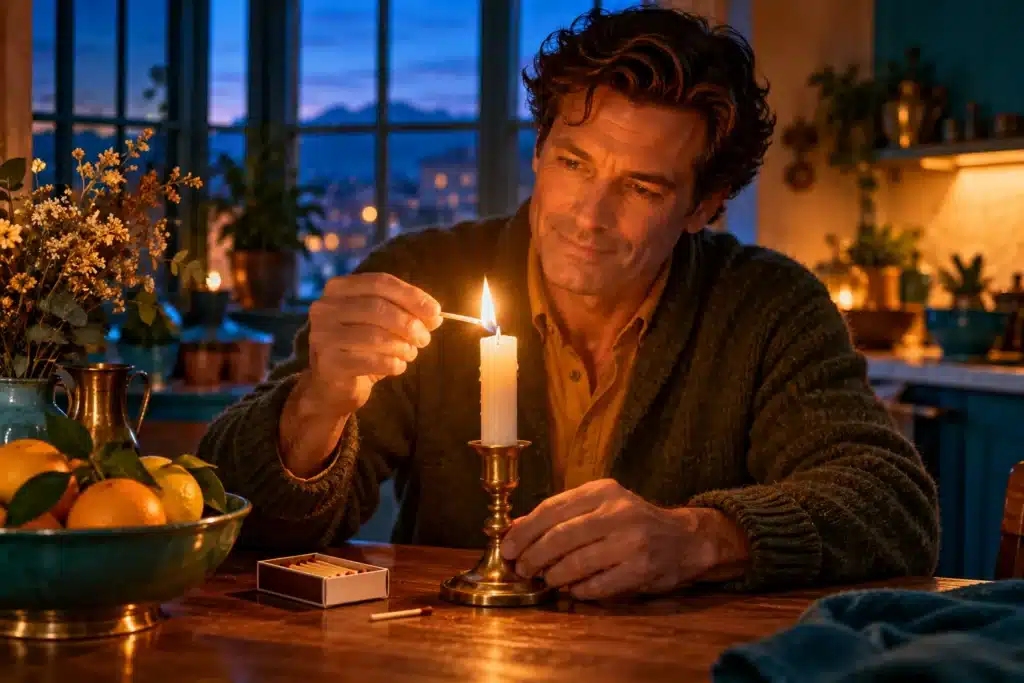
Lighting a candle can feel too small to matter, especially if you are practical or skeptical. Still, people respond to a chosen action before the mind finishes arguing about it. That is the strange part, and it is also the useful part.
The act has a clear start, a visible center and a clean ending, so attention gets a place to land. Meanwhile, the flame keeps moving just enough to hold you. This offers perspective and predicts nothing. With Diwali tomorrow and the dark arriving early on the windows, that tiny flame may feel unusually welcome this week.
Lighting a Candle Works Before You Decide What You Believe
In 2014, two Harvard Business School researchers published three experiments in the Journal of Experimental Psychology: General. In plain English, they looked at what happens when people do a ritual after a loss.
The losses were different on purpose. One involved a loved one, one a relationship, and one a lottery. Afterward, the people who had performed a ritual reported less grief than the people who had not.
The interesting part was the reason. The effect ran through a regained feeling of control. A ritual is a repeated action with meaning attached, even when that meaning stays private, and a loss tends to make life feel scattered. Lighting a candle draws a small edge around a feeling that has no edges.
Here is the result most people do not expect. The effect held for participants who said rituals do not work, as well as for those who believed in them. So the candle does no grand work. The chosen action gives the moment a shape.
What a Flame Does That a Light Switch Cannot
A light switch is efficient. You press it, the room changes, and your mind barely registers a decision. Lighting a candle adds friction, and friction is what focuses attention.
You find the candle. You find the box. A box of kitchen matches costs about a dollar, and the first match usually snaps. That tiny failure is oddly human.
Match. Then quiet.
After that, you wait. The wick catches slowly, the light steadies and the room becomes slightly different. Because the flame moves, your attention narrows to one small, almost living thing. Your phone can flash and a message can buzz, yet the candle gives your eyes a softer job.
I’ve tested the switch version against lighting a candle, for a week last winter. Same chair, same five minutes, a lamp clicked on and off instead of a match. It felt like waiting for a bus. The match version felt like starting something. One man’s week proves nothing, but I find it matched what the research suggests.
I honestly do not know whether the flame matters or only the fact that I chose to strike the match. If you want the opposite approach, where the flame itself is the message, here is what people read in a flame. This piece stays with the simple act.
Why the Ritual Still Works on Skeptics
Belief is optional here. The match does the work.
That sounds blunt, I know. However, the 2014 experiments make room for it. People who said rituals are nonsense still reported a shift after doing one. The doing counted, whatever they thought about it.
So the common idea that lighting a candle only helps people who already believe in it deserves to go. It flatters certainty too much. A small ritual can steer attention long before belief joins the room, if it ever does.
My grandmother lit a candle every Sunday night and I teased her about it for years. When she moved in with my aunt, I got the brass holder, mostly because nobody else wanted it. I kept the habit going in my own apartment without ever deciding to. And I still could not tell you what I believe about it. I can tell you that the five minutes after the match are the only five minutes of my week when nobody can reach me.
That is the whole case for lighting a candle, really. No speech and no demand for faith. Instead, there is a boundary: these five minutes begin here and end there. If you like that idea, the broader skill is turning ordinary habits into small ceremonies. Before dinner, after work, while the room settles.
Dark Evenings, Diwali and an Old Human Habit
By November 7, the darkness has a different weight. US clocks went back on Sunday, November 1, and on November 7 the sun sets at 4:45 PM in New York. The evening arrives before many people feel ready for it, which is exactly when lighting a candle starts to feel less like decoration.
Meanwhile, Diwali falls on Sunday, November 8, 2026. The Hindu holiday is widely known as the festival of lights, and homes light rows of small oil lamps for it. Diwali has its own sacred meanings and family practices, and it deserves to be described in its own terms.
Still, the date points to a very old human habit, and I’m convinced it explains the pull: people light a flame when they cross a threshold. The threshold may be seasonal, spiritual or emotional. When the outside world goes dark, a chosen point of light makes a room feel less shapeless.
Lighting a candle at home on a dark evening borrows nothing from anyone’s tradition. Done simply, it marks a pause before the next task, the next screen, the next worry.
Lighting a Candle on Purpose: A Five-Minute Version
Here is the practical version. You need no special colors, spell words or perfect mood, and the ritual should stay small enough to repeat.
Choose one thing to think about, such as ‘the conversation I am avoiding’ or ‘the task I keep postponing’.
Place the candle on a stable surface, away from curtains, paper and pets. Never leave a flame unattended.
Strike the match, even if the first one snaps, and notice the beginning.
Sit for five minutes. When your mind wanders, look back at the flame without scolding yourself.
Blow it out to mark the end, then name one next step you can take today.
If you like a little more structure, here is a ritual that fits into a few minutes. Keep this version separate from bigger ceremonies, though. It is a pause with edges.
Lighting a candle will not decide your future. What it can do is give one ordinary November evening a beginning, a middle and an end. On a week this dark, I have found that is usually enough to make the next hour easier.
The post Why Lighting a Candle Still Works, Even If You Do Not Believe In It appeared first on askAstrology.