
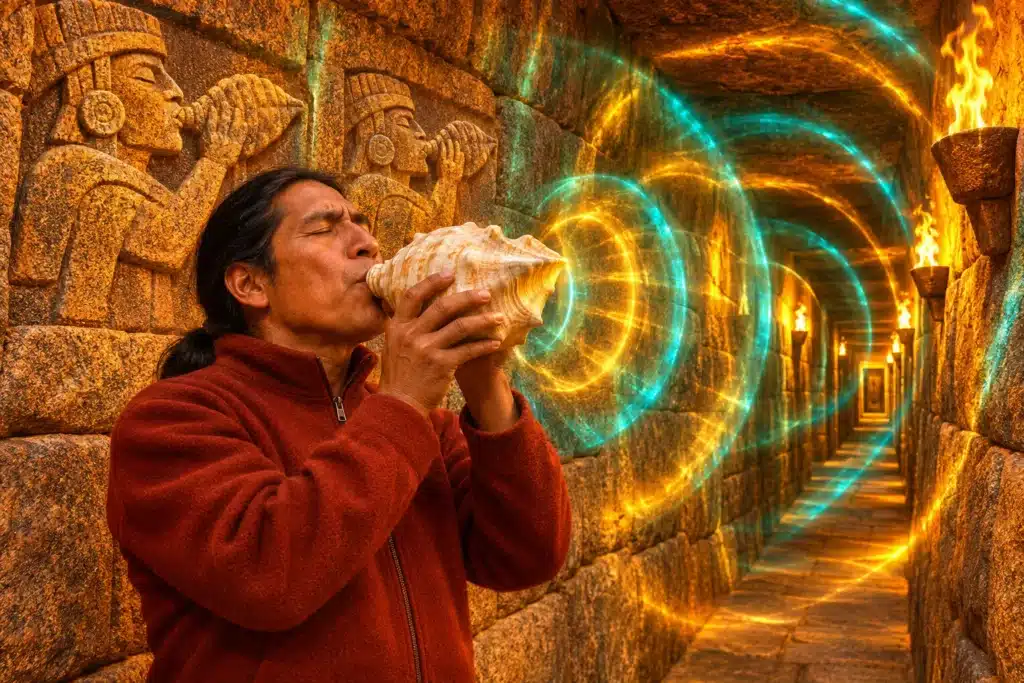
Chavin de Huantar holds a sound mystery that you can almost hear before anyone explains it. In the stone corridors of this sanctuary in the Peruvian Andes, modern musicians have felt something strange: their shell horns seemed to lean toward a note on their own, as if the building itself were joining in.
The effect has an acoustic explanation. The open question is another one: did the people who built Chavin understand it, and did they weave it into their ceremonies? This offers perspective and predicts nothing.
What Chavin de Huantar Was Built For
Chavin de Huantar stands at about 3,180 meters in the Peruvian Andes, where mountain air thins the lungs and sharpens attention. According to UNESCO, the site gave its name to a culture that developed there between 1500 and 300 BC. It was a ceremonial center, a former place of worship that people traveled to for ritual.
The visible stone matters, yet the hidden stone may matter even more. Inside the buildings run kilometers of narrow corridors and canals, which archaeologists call galleries. A gallery here means a stone passage that can direct movement, water, air and sound.
That detail changes the mood. The old cliche says that ancient temples were built on superstition alone. Chavin de Huantar makes that line feel lazy, whatever its builders had in mind. Stone shapes a voice, and these corridors shape it in a way you notice.
For a plain geographic anchor, see the ceremonial center in the Andes, described with the sober clarity this subject deserves. Still, even sober facts can raise gooseflesh. A mountain complex, dark passages, hidden canals and sound instruments found underground make a rare acoustic invitation.
The Shell Horns Found Underground in 2001
The only sound instruments known from Chavin de Huantar are pututus, conch shells turned into horns. They came from the sea, while the sanctuary sits high in the Andes, so each shell carried distance in its body before it ever carried breath.
In 2001, the team of archaeologist John Rick found 19 of them at the site, and excavations have brought up 21 to date. Stone carvings there show figures holding the shells. Miriam Kolar, Perry Cook, Jonathan Abel and their colleagues then studied the instruments and how they relate to the architecture, notably in a publication from 2012.
The first time I blew a conch shell, on a beach in Florida, I got spit and a squeak. The man selling them told me to stop blowing and start buzzing, lips loose, like a bored horse. My second try came out low and enormous, and a dog two blankets over stood up and stared. I think of that dog whenever I read about the horns of Chavin. Sound you can feel changes how people stand in a room.
Because ancient ritual often mixed number, place and performance, the pututus also remind me of an oracle people consulted with numbered answers. Different tools, different cultures, yet the impulse feels familiar: create a focused setting, then let attention gather.
When the Corridors Pulled the Notes Into Tune
In 2008, researchers turned an empty room of the national museum at Chavin de Huantar into a small acoustics lab. The original horns sounded from about 272 to 340 hertz, a few notes rising from around middle C, and the Peruvian musician Tito La Rosa played them. Those were measurements in a museum room, which is worth keeping separate from what happens inside the galleries.
In a 2014 presentation to the Acoustical Society of America, Kolar described two effects. When two horns play close frequencies together, listeners hear a warble and often credit the players. Acousticians call it beats. And inside the narrow galleries, the resonances of the horns couple with the resonances of the stone.
That is where the strange feeling inside Chavin de Huantar comes from. Players today report their tones being ‘pulled into tune’, felt in the body as much as heard, and Kolar called these ‘phantom instrument guides’. It is the experience of contemporary musicians. Nobody left a written account of it from the time of the temple.
The walls answered.
Old evidence can surprise us once it gains a technical frame. Ask anyone fascinated by a 3,000-year-old papyrus that seems to track a star: a precise observation from the past can suddenly feel close.
What Nobody Can Prove About Chavin de Huantar
Measured acoustic effects do not reveal what the builders intended. We do not know precisely what people at Chavin de Huantar heard during ceremonies, how they moved through the galleries, or what meanings they gave to the sounds. The idea that the builders designed the architecture to produce a religious experience is plausible, and it remains an unproven scenario.
So I keep four readings side by side, and I’d rather leave them open than pick one:
Physical: resonance, interference, and the interplay of instrument, musician and stone.
Perceptual: a sound made by that whole system can feel like an outside force acting on you.
Ritual: these properties could have deepened immersion and the authority of the sanctuary.
Spiritual: a divine reading is possible within its own culture, though we cannot simply lend it to the people who stood there.
None of this needs an unknown energy. The subject stays striking with plain physics, which is the part I find most moving.
What Chavin de Huantar Teaches Anyone Who Uses Sound
Chavin de Huantar belongs to a family of places that change what we experience: a stone church, a cave, a tiled stairwell. Anyone who chants, hums, sings or uses singing bowls knows the feeling. People usually describe sound practice as inner work, while the room quietly does half of it.
If you are curious about how sound is used in energy work, begin with the space before you reach for grand claims. A chakra is a traditional subtle-energy center in the body. Whether you read that language as symbol or as spirit, the room changes what you perceive.
Try the comparison yourself. Hum one steady note outdoors, where nothing answers. Then hum the same note in a stairwell, a tiled bathroom and a hallway. Notice where your tone feels supported, blurred, swallowed or brightened, and where it seems to settle on its own.
I’ve done this in the concrete stairwell of my building, late, when nobody was coming home. On the third landing one low note suddenly doubled, and I felt it in my teeth. I’m sure a physicist could explain it in a sentence. I still went back the next night to find it again.
The post In This Peruvian Sanctuary, the Building Seemed to Play Along With the Musicians appeared first on askAstrology.
