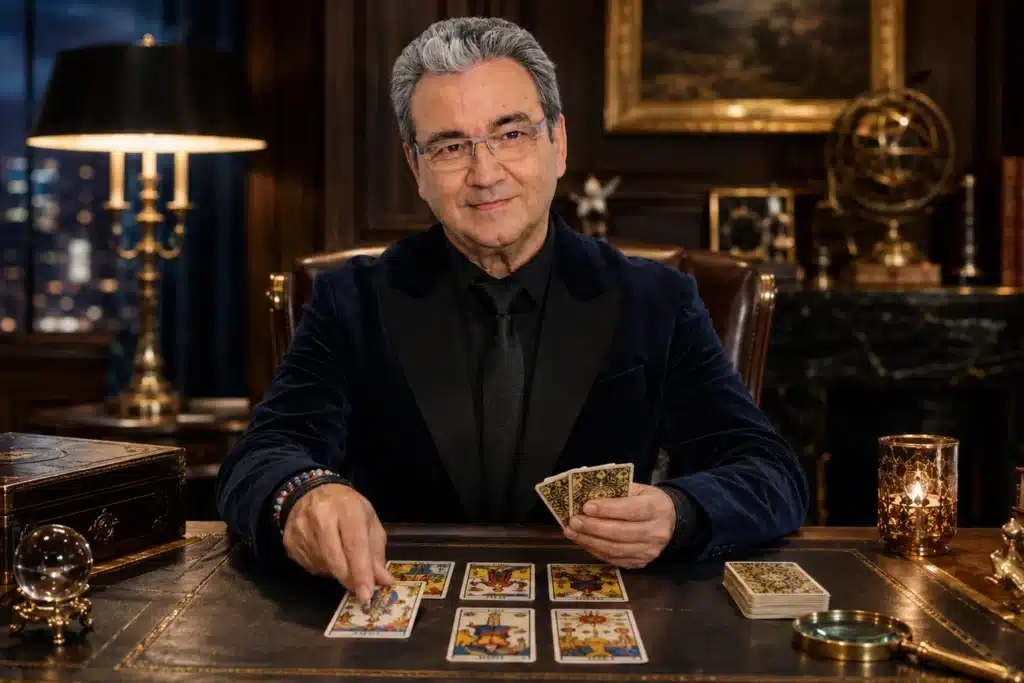
The first time someone sent me a clip of Jean-Didier, I’ll admit my first move was to check whether the man was an actor. He was on a French prime-time set, shuffling a Marseille tarot deck in front of a host who was visibly enjoying the chance to test him, and he did not flinch once. Then I looked up his publishing record. It goes back to 1990. You do not survive thirty-five years of French television on charm alone, which is a little ironic, because luck is the one subject Jean-Didier has never stopped talking about. In September 2026 he finally brought that work into English, which is why you are reading about him now and not five years ago.
Who Is Jean-Didier? The Psychic France Grew Up Watching
Jean-Didier, or JD to people who know him, started reading professionally in the late 1980s, hosting radio at night and doing readings in the hallways between shows. His boss noticed and put him on air every Saturday morning. Within months he had a four-hour daily slot on a Normandy network. Television came in 1993, on TF1’s Mysteres.
What followed reads like a map of French broadcasting. M6 booked him for Normal Paranormal, live, in prime time, seated opposite a psychiatrist. TF1 brought him back twice for Christophe Dechavanne’s La Soiree de l’Etrange. France 2 put Jean-Didier on Sophie Davant’s daytime shows across four separate years. Then France 5, TMC, NRJ12, RTL, and Cyril Hanouna’s studio, where he has been a regular since 2022. His listing runs past sixty television credits and as many radio appearances.
It did not stay French, either. Swedish and South Korean crews both interviewed him in 2007, and Portugal flew him in to lecture. He held a column on past lives in the magazine Horoscope for over ten years. Cosmopolitan ran him in a special issue on divination, where a journalist wrote that his real gift was communication. He still quotes the line, and says it flattered him more than any praise of his readings.
The shape will feel familiar if you read our profile of Tyler Henry, the medium who became a Hollywood fixture. The difference is the era: Jean-Didier built his audience before streaming, live, with no second take. His full record is worth a look.
The Jean-Didier Psychic Method: Marseille Tarot First, Numerology Second
Ask him what he actually is and he refuses to pick a lane. “Psychic, medium, tarot reader or numerologist? I am a little of all of it,” he told one interviewer. After thirty-odd books, that is hard to argue with.
He describes himself as clairaudient and clairvoyant, and says he became a medium after a difficult event at fifteen. But the tool he keeps coming back to is the Marseille tarot, which is a fitting choice for a Frenchman. The deck began as an Italian card game in the 1430s and only became a divinatory instrument in France, around 1780. Jean-Didier works inside a tradition nearly 250 years old.
His reasoning is unromantic. The cards give him a concrete starting point, they are less exhausting than working with nothing, and they confirm what he already senses. That is a craftsman describing his tools, not a mystic selling magic. Anyone learning how to approach a tarot reading will recognize the logic.
Numerology sits right underneath. His fourth book, in 1994, was a numerology method built on the tarot, and numbers have run through his work ever since. The Jean-Didier luck guides teach dominoes, runes, astrology and numerology side by side, on the theory that no single system answers everything. Anyone drawn to that layering ends up curious about which numbers are supposed to carry luck.
Jean-Didier also built his own decks: a Hindu oracle, a divinatory tarot from France Cartes, and most recently the Taromino, twenty-two dominoes mapped to the major arcana and the twelve houses of any natal chart. I’ve handled a lot of novelty decks and most are a repackaged Rider-Waite. This one is not: it reads a card sitting in a house the way an astrologer reads a transit moving through one.
Thirty Books, One Obsession
The bibliography makes the pattern obvious. Bussiere published his first method in 1990 and kept publishing him for three decades, with Hachette, Albin Michel, Tredaniel and Piktos following. The Jean-Didier bibliography covers magnetism, healing, karma, crystals and past lives, but one theme keeps resurfacing: luck. Attirer la chance et le succes alone has been reissued by Hachette in hardback, in paperback and as a boxed set, plus a version for luck in love. His 2026 title translates roughly as the secret codes of luck, finally revealed. Thirty-five years of work, and he is still circling the same question.
Almost all of it is in French. What he has put in English so far are digital tools rather than books: monthly rituals, a prosperity talisman, audio frequency sessions, gathered in a small shop on his site.
What He Means by the Luck Code
Here I’d push back slightly, because the language on his English site runs bolder than the man himself does in interviews. His actual position, stripped of the marketing, is that luck behaves like a skill rather than a lottery ticket. Some people notice openings, act on instinct and follow through. Others do not, then describe themselves as unlucky. In my experience reading for people, that gap is real and depressingly consistent.
That is not a supernatural claim, and it lines up with something we write about constantly: attention is trainable, and so is the intuition you have been ignoring. Where Jean-Didier goes further is in stacking ritual, timing and divination on top, which you can take or leave.
One thing to be clear about, since he gets asked constantly: Jean-Didier sells no winning numbers and promises no jackpot. His luck work is about noticing and acting, not about beating a draw.
Is the Jean-Didier Psychic Quiz Worth Two Minutes?
I took the quiz, because I was not going to write this without taking it. Ninety seconds, answered honestly, which is the only way it works. Two of my six answers were the hesitant ones and I knew it before the score loaded. That was the useful part. The questions are better than most quizzes of this kind because they measure behaviour rather than personality: they ask what you did last time, not who you think you are. So the luck score he hands you at the end is really just a conversation starter. If you pick “I hesitate and usually let it pass” twice, as I did, that is your finding, and no algorithm produced it.
It all sits behind a free two-minute quiz. Thirty-five years in, he is finally doing it in English.
The post Meet Jean-Didier: The French Celebrity Psychic Who Says Luck Is a Code appeared first on askAstrology.