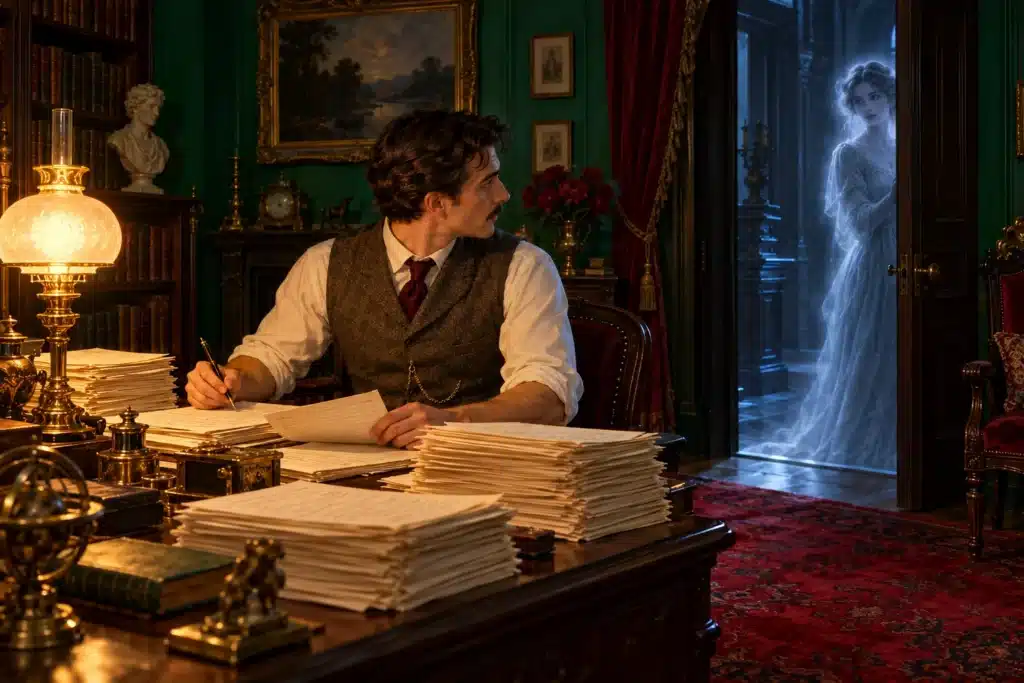
In 1889, British researchers asked practically the same question of 17,000 people: had they ever, while believing they were awake, seen, heard or felt a presence with no apparent outside cause? That question became the Census of Hallucinations, one of the strangest data stories of the Victorian age. Some of the reported apparitions seemed to coincide with the death or crisis of someone far away. Did those coincidences really happen more often than chance allows, or were memories adjusted after the news of a death arrived?
Drop the myth that the Victorians proved ghosts exist. What they did was harder and more interesting: they tried, with imperfect tools, to turn an apparition into a number.
The Census of Hallucinations Asked One Simple Question
Before the history, answer it yourself. Have you ever, wide awake, heard your name with nobody there, or felt someone standing behind you? Hold your answer. I’d bet you hesitated, and that hesitation matters later.
A committee of the Society for Psychical Research, chaired by the philosopher Henry Sidgwick, ran the Census of Hallucinations. For background on the society that ran the survey, picture a serious Victorian group trying to bring order to claims that usually travel as rumor. The report appeared in 1894 in the Society’s Proceedings. Cambridge University Library holds its archives, covering 1882 to 1895.
The scale was the hook. Answers from 17,000 British respondents made the Census of Hallucinations feel unusually solid for its time. However, size alone settles nothing. A big pile of answers can still carry bias, memory gaps and loose timing, and the wording of the question already decided what would count.
1,684 Yes Answers and a Twelve-Hour Window
Out of 17,000 British respondents, 1,684 said yes. That is about 9.9 percent, using the definition the committee applied. Because the question covered sight, sound and a felt presence, it gathered a broad range of experiences, far wider than the classic ghost story.
Then the committee behind the Census of Hallucinations narrowed its focus. It studied recognized apparitions, where the person seen could be named, within a twelve-hour window around the death of that person. That phrase is the hinge of the whole study: a twelve-hour window around a death. A figure seen close to the time of dying went into the chance comparison.
The committee’s verdict was bold. These recognized apparitions, it concluded, occurred more often than chance should produce. Yet that conclusion leaned on three things at once: the honesty of the reports, the accuracy of the times, and the width of the window itself. Widen the window and the count of matches rises. Narrow it and the count falls.
Why Chance Is So Hard to Rule Out
Chance sounds simple until people start remembering. The people in the Census of Hallucinations were never a random sample in the modern sense. The interviewers were volunteers, often close to the Society, which shapes who gets asked and how a story is heard.
Many reports concerned old events, so people had to rebuild the times after the fact. A vague morning can become very precise once a death gives it weight. Meanwhile, the misses quietly vanish: hunches that never matched, voices nobody connected to anything, stories reshaped after the news. Those are the hardest things of all to measure. A spooky story without its failures is half a dataset. Count the misses.
My aunt swore she heard her brother call her name the morning he died. Years later I asked how many other mornings she had heard a voice in the kitchen. ‘Oh, plenty,’ she said. ‘I just never wrote those down.’ We both laughed. Neither of us changed our mind.
I cannot tell you what those 1,684 people saw. Nobody can now. Late in the 19th century, the psychologist Edmund Parish reanalyzed the surveys and pushed on exactly these weak points: hindsight memory, shifting definitions of a hallucination, and errors of timing. His point was about method. When definitions move, results move with them, and the telepathy reading loses its footing.
Six Ways to Explain What People Saw
The Census of Hallucinations leaves six explanations on the table, and the survey proves none of them. Because the data came from reports, each one has to stay modest.
Coincidence: in a population this large, some experiences will line up with deaths by accident.
Memory bias: once the news of a death arrives, an ordinary memory takes on a new meaning.
Half-sleep, grief or stress taken for wakefulness: people may honestly believe they were fully awake.
Ordinary hallucinations: perceptions without an outside cause, now known to occur in the general population.
Crisis telepathy: distress sent across a distance, an idea some investigators defended and the census never showed.
Survival after death: more speculative still, since many apparitions were reported before or around the death, as brief appearances with no lasting contact with the dead.
If you want modern language for the kinds of presence people describe, keep the historical limit in mind: the census measured reports. Likewise, meaningful coincidences can feel charged while their cause stays open. Spiritual readers may lean toward telepathy or survival, and skeptics toward memory and coincidence. The honest middle ground holds: the old data cannot decide for us.
What the Census of Hallucinations Teaches About Your Hunches
The Census of Hallucinations teaches one practical habit: write before you check. When a hunch arrives, record the time, the content and your confidence before you find out what happened. Then record the outcome, misses included.
I’ve kept a hunch log on and off for years, in a cheap spiral notebook by the kettle. My early pages looked impressive because I mostly wrote down the hits. Once I logged everything, the picture got humbler and far more useful. I’m still prone to the occasional chill. I just know my real hit rate now, and I trust the good ones more for it.
Here is the simple version:
Time: note when the impression came.
Content: write the plain claim, unpolished.
Confidence: mark how strongly it felt in the moment.
Outcome: add hits, misses and vague fits, especially the boring ones.
You can compare your log with a later attempt to collect premonitions, where the same timing problem shows up again. Was chance enough in 1889? Maybe for some cases. The Victorians could not settle it, but they left a lesson worth keeping: an extraordinary story deserves careful counting, and the counting starts before the story gets told.
The post 17,000 People Were Asked About Ghosts. Was Chance Enough? appeared first on askAstrology.