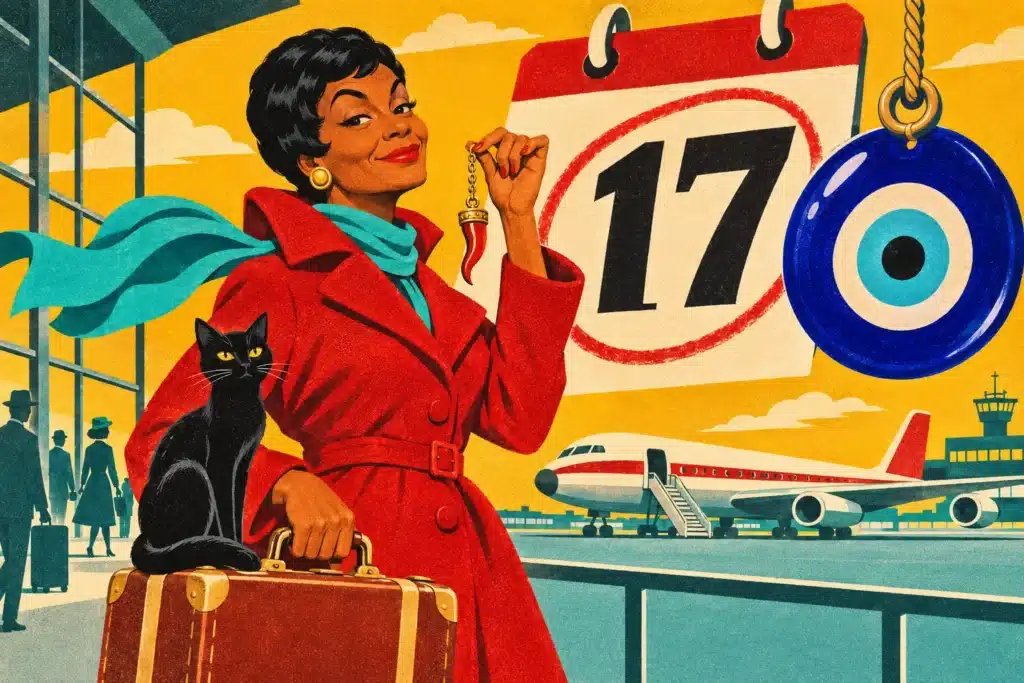
Unlucky days around the world refuse to share one calendar, which is deeply inconvenient for anyone trying to panic efficiently. Today, November 13, 2026, is Friday the 13th in the US, so America is clutching its pearls and side-eyeing ladders. Meanwhile, Italy is basically checking its watch.
Because bad luck has local paperwork, the cursed date changes as soon as your plane lands. Spain and many Spanish-speaking countries watch Tuesday the 13th. Greece also distrusts Tuesday. China, Japan and Korea worry about the number four instead. Wrong country. Wrong day.
This offers perspective and predicts nothing. Still, unlucky days around the world reveal how fear gets dressed up: a number, a weekday, a story, and one poor calendar square taking the blame.
Unlucky Days Around the World Rarely Agree
The American version is loudest today because Friday the 13th has had excellent marketing. However, there is no record of Friday and 13 being called unlucky together before the 19th century. T. W. Lawson’s 1907 novel Friday, the Thirteenth helped spread the idea, because apparently even bad omens need a publicity department.
If you want a lighter take on the American date, keep the jokes ready. Still, American folklore is one local rule among many. Every culture picks a day to blame.
Italy’s next big flinch comes on Friday, September 17, 2027. Spain, the Spanish-speaking countries and Greece get their next Tuesday the 13th on April 13, 2027. Meanwhile, East Asian number customs show up every single day, in elevators, phone numbers and room labels.
Unlucky days around the world stick because they feel practical. A date arrives, the mood in the room shifts, and someone suddenly remembers a grandmother muttering a warning over coffee. I’m not sure anyone fully believes these, but I’ve never seen anyone break one on purpose either.
Italy and the Trouble With Seventeen
Italy’s unlucky number is 17, especially when it lands on a Friday. The reason is deliciously grim in that old-world way, like black espresso served beside a marble tomb. XVII, rearranged, spells VIXI. In Latin, vixi means ‘I have lived’, which reads as ‘my life is over’. Subtle? Absolutely not. Effective? Sadly, yes.
Meanwhile, 13 has a much better reputation in Italy, where it is mostly seen as a lucky number. Among the unlucky days around the world, that Italian twist should make Americans pause before treating their superstition as cosmic truth with a passport.
I once booked a cheap flight to Rome for a Friday the 13th, proud of not being superstitious. My Italian landlady looked at the date on my boarding pass and laughed. ‘Thirteen is fine here,’ she said. ‘Come back on the seventeenth and I will hide your keys myself.’ Then she showed me the red horn charm above her door and swore it was only decoration. She touched it twice on the way out.
The pop-culture proof is perfect. A 2000 American parody of the Friday the 13th films came out in Italy under a title about Friday the 17th. Same joke, different corpse-flavored number. Localizing fear is still localization.
Tuesday the 13th in Spain, Latin America and Greece
In Spain and many Spanish-speaking countries, the warning date is Tuesday the 13th, martes trece. Friday can sit down. The Tuesday problem carries sharp metal in its pocket because the day is named after Mars, the Roman god of war, so it already walks in wearing combat boots.
Greece has its own Tuesday unease. Tuesday belongs to Ares, the Greek god of war, and history then piles on like a rude dinner guest. Constantinople fell on a Tuesday twice: April 13, 1204, and May 29, 1453. Those are hard historical dates, and a city that falls twice on the same weekday leaves a long memory.
There is another Greek detail with old teeth. In Greek, Tuesday is Triti, ‘the third’. These stories last because people inherit them through warnings, jokes and family rules, usually all three at the same dinner table.
So, on April 13, 2027, martes trece, the Spanish entry on the list of unlucky days around the world, will do its little spooky dance again. Most people will go to work. Someone, somewhere, will still postpone a wedding, whisper a saying, or blame the day for a broken mug. Humans love a scapegoat with a schedule.
When the Number Four Is the Problem
In China, Japan and Korea, the number four carries the trouble. The word for four sounds like the word for death in these languages, so the number can feel charged even when nobody is screaming about doom. Language does the haunting here. One syllable walks in, and the room gets colder.
Because sound matters, the practice shows up in visible ways. Some Hong Kong towers skip floors 40 to 49, going from the 39th straight to the 50th. The elevator panel looks calm, while the missing numbers stand there like ghosts in a designer suit.
This is where one cliche gets lazy: the idea that superstitions are only for gullible people. Please. Buildings, hotels and developers respond to buyer comfort, rental value, family tradition and public expectation. That is culture working through concrete, steel and a very expensive lobby orchid.
The number four also proves that unlucky days around the world can be numbers, sounds, floors or a room key handed over at reception. For more seasonal customs with less elevator dread, compare what other countries do at midnight on December 31 or trace where Halloween really came from.
What Unlucky Days Around the World Have in Common
Unlucky days around the world work because fear needs a name and a date. After that, the mind can file the feeling somewhere tidy. Friday the 13th became the American villain partly through modern storytelling, with Lawson’s 1907 novel doing a lot of the heavy lifting. The paired fear of Friday and 13 is about as old as your great-grandparents’ furniture.
Folklore survives because it gives anxiety a costume. A vague worry becomes Tuesday. A bad mood becomes 17. A skipped floor becomes etiquette. For a broader look at how superstitions take root, notice how repetition, community and memory turn habits into rules.
Spend today lightly. If Friday the 13th makes you tense, do one small kind act and let that be your counter-spell. Hold a door. Text the person you keep meaning to text. Tip well if you can. And keep the jokes pointed at the calendar, never at somebody else’s grandmother. I’ll be doing my kind act early, then taking the stairs, purely for cardio, obviously.
The post In Italy, Bad Luck Lands on Friday the 17th. Here Is Where Else It Moves appeared first on askAstrology.